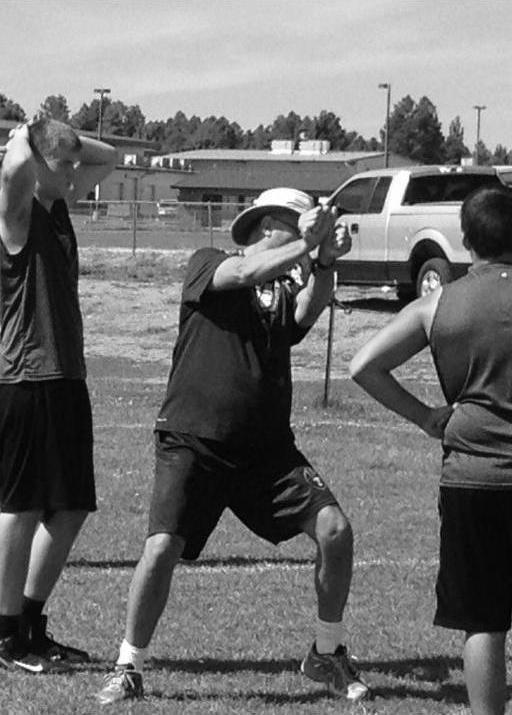
Don Krolak
Coaching Portfolio
“...producing educated men of character who go forward 0
to become great principle-centered leaders, loving
husbands and fathers, and selfless servants to their
community
Donald Krolak 2016 Portfolio
Table of Contents
Career Highlights......................................................................................................................................... 1
Philosophy................................................................................................................................................... 3
Coaching Philosophy...................................................................................................................... 3
Defensive Philosophy .................................................................................................................... 4
Offensive Philosophy..................................................................................................................... 4
Specials Teams Philosophy............................................................................................................ 4
Working with Parents .................................................................................................................... 5
Working with Athletes................................................................................................................... 6
Playing Time ................................................................................................................................... 7
Discipline ........................................................................................................................................ 8
Player Code of Conduct ................................................................................................................10
Involving Faculty ........................................................................................................................... 17
Mission, Goals & Objectives ..................................................................................................................... 18
Mission...........................................................................................................................................18
Team Goals ....................................................................................................................................18
Team Objectives............................................................................................................................18
Keys to Building a Successful Program........................................................................................19
Staff ........................................................................................................................................................... 20
Staffing the Program ................................................................................................................... 20
What Coaches Can Expect From Me............................................................................................ 21
What I Expect From My Assistant Coaches.................................................................................22
General Coaching Guidelines........................................................................................................23
Successful Coaching Considerations .......................................................................................... 24
Off Season Expectations ..............................................................................................................25
1
Coaching Responsibilities.......................................................................................................................... 26
Head Coach .................................................................................................................................. 26
Varsity Coaches’ Responsibilities .................................................................................................27
JV Coaches’ Responsibilities........................................................................................................ 28
Freshman Coaches’ Responsibilities........................................................................................... 29
Defensive Coaches Responsibilities............................................................................................ 30
Offensive Coaches Responsibilities ............................................................................................. 31
Special Teams Coaches’ Responsibilities.....................................................................................32
Practice...................................................................................................................................................... 34
Practice Philosophy...................................................................................................................... 34
Drill Philosophy ............................................................................................................................ 35
Practice and Drill Considerations ................................................................................................ 36
Typical Practice Week (In-season) ...............................................................................................37
Game Plan & Sample Scout Reports ......................................................................................................... 38
Game Plan Board.......................................................................................................................... 38
Scouting Workflow ...................................................................................................................... 39
Offensive Scout Report ............................................................................................................... 40
Defensive Scout Report............................................................................................................... 44
Offensive Playbook ................................................................................................................................... 48
Offensive Production 2010-2015.................................................................................................. 48
Click to Activate Each Playbook ...................................................................................................52
Strength Training ...................................................................................................................................... 53
ACKNOWLEDGEMENTS ............................................................................................................... 53
Strength Training Philosophy...................................................................................................... 54
Program Goals:............................................................................................................................. 55
2
Training Guidelines for FOOTBALL ATHLETICISM...................................................................... 55
Motivating the HS Athlete........................................................................................................... 56
Things to Consider ....................................................................................................................... 56
Organization..................................................................................................................................57
Set Rep Cycle.................................................................................................................................57
Seasonal Programs ...................................................................................................................... 58
Collegiate Recruiting ..................................................................................................................... 65
Levels of Interest ............................................................................................................... 65
Recruit Plan .................................................................................................................................. 67
Freshman Year ............................................................................................................................. 67
Sophomore Year .......................................................................................................................... 67
Junior Year.................................................................................................................................... 68
Senior Year ................................................................................................................................... 68
Timelines ................................................................................................................................................... 69
Game Day Time Lines................................................................................................................... 69
Monthly Calendars ........................................................................................................................ 71
Season Checklists......................................................................................................................... 76
Varsity Club ............................................................................................................................................... 77
What It Takes To Be Number One ............................................................................................................ 79
3
Career Highlights
Education
MASTER OF ARTS WITH DISTINCTION: EDUCATIONAL LEADERSHIP
University of New Mexico, Albuquerque, NM.
BACHELOR OF SCIENCE: MATHEMATICS EDUCATION
Ohio State University, Columbus, OH
Teaching Mathematics
TEMPE HIGH SCHOOL, TEMPE, AZ (2011-2015)
o Pre-Calculus, MAT 152, 182, International Baccalaureate Math Standard Level Y1,
o College Math MAT 142, Applied Math, Math Lab
o Adjunct Faculty Member Maricopa Community Colleges
BASHA HIGH SCHOOL, CHANDLER, AZ (2004-2011)
o Pre-Calculus, Algebra II, Geometry
o Adjunct Faculty Member Maricopa Community Colleges
SANTA FE INDIAN SCHOOL, SANTA FE, NM (1995-2004) (1987-1990)
o Trigonometry ,Algebra II ,Geometry
o Administrative Internship
o Math Department Chair
o National Science Foundation Summer Program Discovery Learning Instructor
GOV.THOMAS JOHNSON HIGH SCHOOL, FREDERICK, MD (1990-1995)
o Geometry Algebra II
o Governors Academy for Mathematics, Science and Technology Participant
1
Coaching Football
TEMPE HIGH SCHOOL, TEMPE, AZ (2011-2015)
o Varsity Offensive Coordinator & Offensive Line Coach
BASHA HIGH SCHOOL, CHANDLER, AZ (2004-2011)
o Varsity Run Game Coordinator
o Offensive Line Coach
o Strength & Conditioning Coordinator
SANTA FE INDIAN SCHOOL, SANTA FE, NM (1995-2004) (1987-1990)
o Head Football Coach (1995-2001)
o Assistant Athletic Director (2001-2004)
o Varsity Offensive Coordinator & Offensive Line Coach (1987-1990)
o Strength and Conditioning Instructor (2000-2004
GOV.THOMAS JOHNSON HIGH SCHOOL, FREDERICK, MD (1990-1995)
o Head Freshman Coach & Offensive Line Coach
o Varsity Scout
Coaching Track & Field
TEMPE HIGH SCHOOL, TEMPE, AZ (2011-2015)
o Assistant Coach Sprints (2011-2014) / Assistant Coach Throws (2014-2015)
BASHA HIGH SCHOOL, CHANDLER, AZ (2004-2011)
o Head Track Boys Track Coach (2008-2011) / Assistant Track Coach Sprints (2004-2008)
SANTA FE INDIAN SCHOOL, SANTA FE, NM (1995-2004) (1987-1990)
o Head Track Coach (2001-2004)
o Assistant Track Coach Sprints & Hurdles (1995-2001) (1987-1990)
GOV.THOMAS JOHNSON HIGH SCHOOL, FREDERICK, MD (1990-1995)
o Head Track Coach (1993-1995). / Assistant Track Coach Hurdles & Jumps (1990-1993)
2
Philosophy
Coaching Philosophy
As a Head Coach I am willing to find ways to serve my team, my school and my
community. I will do what I can do to help the people I serve to be their best. As a coach
I have a great opportunity to teach young men to be great leaders by modeling service
to others. You win with people. Therefore know your players and staff and show them
you care. I would not expect my players or staff to passionately care about our football
program if I did not passionately care about them as people. Mission critical towards
developing a successful program is creating a sense of family focused on a singular goal.
Every individual has value, a role, and is important to the team. No single player is more
important than another. As a coach I am a teacher first. What I see on video is what I
have coached. A good teacher knows to keep things simple, not over teach, and is
willing to find the best way to teach. Finally a Head Coach should always be humble,
always give credit, and praise to others. Deflect praise and redirect glory and with
dignity absorb criticism and accept blame.
If human beings are perceived as potentials rather than problems,
as possessing strengths instead of weaknesses, as unlimited rather
that dull and unresponsive, then they thrive and grow to their
capabilities
—Robert Conklin
3
Defensive Philosophy
For teams to be successful you must play great defense. Top priority will always be to have a strong
defense with sound gap and pass coverage integrity. The defensive scheme must fit our personnel, be
flexible and easily adjust to the offenses that we will face. Defensively we will be extremely relentless
in our pursuit of the football and execute our assignments with aggression, determination and sound
fundamentals. Finally high school defenses must be able to stop the run.
Offensive Philosophy
Move the chains and score points is the objective of this offense. Although balance between the run/
pass ratio, but also in how we attack ALL areas of the field is ideal. At the end of the day our ability to
move the football is the key to our success as a team whether it is run, pass, or play action pass. To
achieve this objective we will do a few things but do them well and out of multiple formations. We
will use a limited number of run blocking schemes complemented by either play action or run pass
options. Our pass schemes are structured to attack the defense with patterns that will stretch the field
vertically and horizontally. Our drop back attack will be complemented by play action passes and
screens. We want to maintain a high level of awareness in all the strategic situations. Have an answer
for every situation. Designed, practiced, and ready in advance. We want to be able to get the ball to
our players most capable of making big plays. Our system must allow us to dictate how and when we
get the ball to our best players.
Specials Teams Philosophy
The special teams are an integral part of our success. The special teams have a huge impact on field
position and the momentum of the game. There is no more important factor in an offense scoring or a
defense stopping an opponent than the starting field position of the drive. Maximizing the change in
field position to our benefit will have a positive impact on the likelihood of victory. One in every six
plays is some form of kick. Close games between evenly matched teams will usually be decided by
special teams play. We are going to be aggressive in our philosophy on special teams, just as we are on
both defense and offense.
4
Working with Parents
Keep the Parents Informed
a. Calendar of Events/Practices
b. Communication is the key
i. Facebook, Twitter, Constant Contact, Team Website
Get Parents Involved & Work Parents into the Program
a. Create a family culture.
b. Family BBQ
c. Mom’s Clinic
d. Helmet Striping Ceremony.
e. Chain Crew.
f. Publishing Game Night Football Program.
g. Website Development
h. Boosters.
i. Concessions.
Set the Limits & Boundaries
a. Mandatory Parent Info Night
b. Player Contract / Parent Manual
c. Contacting the Coach parameters.
i. Appropriate Time to approach the coach.
ii. Reasons to meet with the coach
1. Appropriate - treatment of child physically, emotionally
a. ways to help improve
b. behavior concern
2. Inappropriate
a. playing time
b. strategy, play calling
c. other student athletes
5
Working with Athletes
Develop Themes That Players Can Grab a Hold Of
1. Yearly themes
a. (a Mantra)
2. Weekly themes
a. Assigned to Assistant Coaches to present to team and create bulletin boards. Such as,
Discipline, Character, Toughness, Effort, Pride, Commitment, Confidence, and
Teamwork.
3. Daily themes
a. Read “Win Forever” By Pete Carrol
i. Maslow’s Hierarchy on the football field.
ii. Each individual’s basic needs must be met if you wish for them to move towards
doing great things in the program. (freedom from the fear of failure,
acceptance, understanding, belonging, and respect)
iii. Always Compete
iv. Do things better than they have been done before
v. Live with “Arête” can you in this moment express the highest version of yourself.
vi. Practice is everything.
Guide Athletes in Developing Challenging but Attainable Goals
a. Yearly Goals
b. Daily/Weekly Goals (measurable & objective not subjective)
c. Game Goals (posted charts)
d. Push Athletes/Know Their Limits.
e. Keep The Focus on the team. It’s all about the team.
f. Be Process not Product Oriented.
g. WINNING WILL BE A PRODUCT OF DOING THE RIGHT THING
Ideas
a. Monitor Attendance Daily, Off Season Squads, Bi-weekly Grade Checks, Outreach Programs
such as Best Buddies, Player’s Council/Position Leaders/Off Season Squad Leaders.
Community Service, Youth Clinics, Acknowledge the “Program Builders”, Recognize Weight
Room Achievements.
6
Playing Time
Every one of you wants to start on our football team. Unfortunately, not all of you will. The coaching
staff must determine who will start. Consequently, we feel it is important for you to understand how
we will decide on depth charts as practice progresses. The following five points will be the criteria
used in selecting starters and developing depth charts.
1. Knowledge of Assignment:
We cannot and will not play people who do not know their assignments. Your position coach will
spend extra time with you if you so desire. Everyone can and must give 100% Effort.
2. Hustle and Effort:
Everyone will be expected to give 100% at all times. Go full speed whistle to whistle! Your
teammates will be giving 100% and they expect you to do so also. Extra effort wins games.
Everyone can and must give 100%. If
3. Hitting and Mental Toughness:
We will discover during fall practice who is aggressive and mentally tough. Football is a contact
sport and it must be played with mental and physical toughness. Everyone can hit. You must have
“Want To” or you simply will not see playing time. It is dangerous to you and to your team should
we put you on the field before you are ready.
4. Contribution to the Program:
The individual who represents the program well, and motivates his teammates to do better, is
always enthusiastic and ready, will make a greater contribution than one whom does not
demonstrate those qualities. Being coachable and disciplined is critical to our success. One man
who refuses to lose and refuses to allow others to quit or become a distraction is a valuable player.
5. Talent:
If the above four characteristics are equal and they should be, then the young man who has the
most talent, However, talent will not enter into our evaluation until we look closely at the first four
qualities. Obviously if you are missing practice because you are injured or ineligible it will be
difficult for us to evaluate you.
Our best athletes will lead us to a few wins. Our best PEOPLE will lead us to CHAMPIONSHIPS and
make us all legends. We want to live forever in the tradition of the program. All of you who do not
earn a starting position, it is up to you to continue to work hard and be prepared when called upon. You
are always just one play away from playing.
7
Discipline
I build my entire philosophy on coaching and discipline around this simple idea: “That which you
tolerate, you encourage.” That statement will help my kids and staff, understand my approach to
discipline and attention to detail in every aspect of the program. I believe in communicating my
expectations to my staff and my players. I believe in holding them accountable for their actions as well.
I like to keep team rules brief and cut and dry. For example, “Do what is right, always.” I’d like that to
be posted in the locker area and team room. Additionally, I like this rule: “Be where you are supposed
to be, at the time you are supposed to be there, doing what you are supposed to do.” In addition to
those simple rules are simple consequences that each athlete must accept when rules are broken, I
anticipate forming a “Player Council” within the program. The Player council will assist the coaching
staff in providing guidance and structure within the team and give ownership to the players. We will
use a simple system. Each time a player has a discipline problem he will face consequences. He will be
dealt with by his position coaches or the head coach. When he reaches 3 incidents he must face the
Player Council. He must explain his actions and accept his consequences to remain with the team. He
will be suspended for one game. The Player Council will address the young man professionally and with
respect being sure to let him know how he is a distraction to the program and its mission. They will
express to him that he is an integral part of the program’s success and provide suggestions for
controlling his actions. The player will be on a “probation” of sorts. If a player reaches 4 incidents, he
will be dismissed from the team.
Standard Sequence of Disciplinary Actions
First incidence- TBD
Second incidence- TBD
Third incidence-TBD ,Player Council, game suspension”
Fourth incidence- Dismissed from team.
***The purpose of discipline is to provide the athlete with conditioning and an opportunity to
right his actions. We do not seek to belittle or embarrass any student. I believe a student who
continues to attract negative attention is in fact embarrassing himself and the program.
Our program will be known for disciplined structured practices. Structured routines and traditions
will be our norm. We will do things with “military like precision”. Every school rule will be reinforced in
our program. All players will be treated equally and the idea is that “No player is bigger than the team,
no team bigger than the program.” The bottom line, clear expectations, open lines of communication,
swift, tough and fair discipline. I believe that discipline is something you do for someone, not to
someone.
8
A disciplined person knows how to act when no one of higher authority is watching.
A disciplined team doesn’t self-destruct.
In summary regarding kids who might be outsiders or different in some ways, it’s my responsibility, my
staffs responsibility and the mission of the program to make them feel a part, make them feel
important and to provide life lessons that improve their quality of life. I expect many boys lives will be
changed due to the impact of our quality staff and team. No boy will be disregarded due to playing
ability. No boy is so great a challenge that we would not do our best to make a positive impact on his
life. No effort is too great when it comes to a young man’s future.
9
Player Code of Conduct
The Code: Goals of our team
I. To develop young men who are respected for overcoming adversity, accepting challenges with
enthusiasm, and for being positive, productive members of our society. People with strong enough
character to do the right thing all of the time.
II. To create student-athletes who will get the most out of themselves. Student- athletes who are
internally motivated to make themselves better and give everything they have every time. Student-
athletes who value the team over the individual.
III. To produce football players who are confident in their abilities, training, and conditioning. Football
players who know that they can win every game they are in, regardless if they do or do not.
The Code: Academic Eligibility
Football players must be eligible and have a 2.0 grade point average. Players on academic probation may
be required to attend study hall(s) to improve their grades. Ineligibility does not necessarily exclude a
player from responsibility of the program. Chronic ineligibility, whether in season or not, may result in
removal from the program.
The Code: Class Attendance
Football players who are truant from a class will additionally be ineligible for practice and/or a game. A
missed game or practice will carry additional penalty of an unexcused absence.
The Code: Workouts/Team Meetings
Football players must attend mandatory workouts or meetings, and be on time. All missed practices,
excused or unexcused, will need to be made up. A missed practice is considered a missed opportunity to
get better. To reduce the impact on a player, an absent player will be given the opportunity to make up the
practice by running (for a predetermined time and under the supervision of a coach). This is not a
punishment and thus will be considered in addition to any running requirement for an unexcused absence.
Failure to attend a mandatory meeting/practice without excuse will result in:
1st Offense: Opportunity
2nd Offense: Opportunity and suspension for first half of next game
3rd Offense: Opportunity and suspension for next game
4th Offense: Dismissal from the team
10
A tardy player can expect the following consequences:
1st Offense: Opportunity
2nd Offense: Opportunity and suspension for first half of next game
3rd Offense: Opportunity and suspension for next game
4th Offense: Possible suspension from the team
5th Offense: Possible dismissal from the team
*Please note that decisions of dismissal will be the sole decision of the head coach.
During the Spring, Summer and Fall, practices will be considered mandatory/optional which is determined
by the head coach. To be excused from any practices/meetings, a parent/guardian note or phone call must
be provided to the Head Coach at least 24 hours before the absences. If calling, the only acceptable excusal
is to speak directly to the Head Coach. This does not include leaving a voice message. Failure to clear the
absence before the missed practice will result in missed practices being considered unexcused.
*Please note that decisions of dismissal will be the sole decision of the Head Coach.
During the Spring, Summer, and Fall, practices are considered mandatory or optional as determined by the
head coach. To be excused from any practices/meetings, a parent/guardian note or phone call must be
given to the Head Coach at least 24 hours before the absences. If calling, the only acceptable excusal is to
speak directly to the Head Coach. This does not include leaving a voice message. Failure to clear an
absence before the missed practice will result in missed practices being considered unexcused. Also,
remember that the player may have to compete with others whose performances have improved during
that player’s absence.
While the coaching staff believes in and supports family vacations/travel, please try to schedule vacations
and/or trips at a time that will disrupt your player’s practice/game schedule least. The coaching staff would
be happy to discuss with you options that will minimally impact your player’s performance and the total
team’s success.
The Code: Off Season Requirements
Spring football practice is a requirement to participate in the Buffalo Football Program. In addition,
participation in track and field (or another Spring Sport) is required. We will use our track and field
program as a base for off-season conditioning. Working together, we can help make more than just
football successful at Tempe High School.
Attendance at both the summer workouts and Camps are a requirement for play and participation in the
fall football season. Any player who misses summer camp will not only lose the opportunity to build team
relationships and better himself as a player, but, will not be assigned to the Varsity squad until further
proof of performance/ability.
11
The Code: Behavior
Unless otherwise indicated, infractions of the expectations in this section will result in the assignment of a
consequence that may include but is not limited to:
Immediate apology(s)
Opportunity
Opportunity and possible consequence
Dismissal
PLAYER EXPECTATIONS
1. Football players will be respectful to all. Especially school employees, officials, parents, teachers
and other students.
2. Football players will be respectful to coaches and will refer to coaches as “Coach” or “Sir”.
3. Football players will maintain composure during practice and competitions. They will not argue
with or demean officials, opposing coaches and/or players.
4. Football players will not curse or swear.
5. Football players will refrain from horseplay or rough housing.
6. Football players will not litter the locker room or campus.
7. Football players will enthusiastically follow directions given by a coach. Sullen or reluctant
behavior is not tolerated.
8. Football players will respond to questions asked of them with a “Yes, Coach,” “No, Coach,” “Yes,
sir,” or “No, sir.” The same respect will continue in the classroom and on campus.
9. Football players will be honest. Players who cheat or lie will be punished and/or dismissed.
10. Football players will treat school property with care. Vandalism will be punished and could result in
removal from the program, a monetary fine and/or prosecution.
11. Football players will not steal. Anyone found stealing from the locker room will be dismissed and
prosecution will be recommended.
12. Football players will conduct themselves with dignity and class at all times.
13. Football players will win the same way they lose, with class. Players will quickly return to and from
the sidelines. Players will cordially shake the opponent’s hands.
14. When on the road, players will enthusiastically follow all schedules designed by the coach.
15. When on the road, players will never leave the premises of competition without requesting
permission from the coach.
16. Football players will be responsible in completing all paperwork (i.e. physicals, clearances,
transportation fees, equipment returns, etc.).
12
PARENTS/GUARDIANS/FANS EXPECTATIONS
1. Be positive and encouraging towards players and coaches.
2. Treat officials, game personnel and administration with respect.
3. Be respectful to other fans (you may have an opinion but, not everyone needs to hear it).
4. Be respectful and courteous when addressing a coach, player or administrator and expect the
same.
5. Get involved in the Booster Club (parent organization) and/or any team support organization
effort.
6. Practices and/or games are not an appropriate time to have a discussion with the coaching staff.
Please schedule a time to meet with a coach at an appropriate and convenient time for everyone.
At no point will play calling or coaching philosophies be an issue of discussion.
7. The entire athletic department appreciates and encourages community participation in our
activities. However, if behaviors develop that are detrimental to the entire community’s
participation, the right to participate may be revoked.
The Code: Courtesy
Football players will follow all directions and direct commands of those in authority. If a question
arises regarding the directions, the player will wait until an appropriate time to address the coach or
other person in authority. At this time respect and courtesy for authority will be maintained at all
times.
The Code: Drugs, Tobacco & Alcohol
Football players will not use tobacco of any kind.
Football players will not use alcohol.
Football players will not use drugs, possess drugs/paraphernalia, or be in the presence of such
items.
Football players who have a problem with substances are encouraged to seek help for chemical
dependency. Such players will be treated with privacy, and coaches will do everything in their
power to help such players. Players who are reported to the coaches as alcohol or drug users
will be given the opportunity to seek help. Players who partake in alcohol and drugs will be
subject to the rules of the school governing these issues. In addition, on the first offense, any
player found to have taken drugs or alcohol will be, at the least, suspended for the following
competition or perhaps dismissed. A second offense would therefore result in dismissal.
13
The Code: Injuries
Football players will report to the coach and trainer for treatment immediately upon being injured. All
injuries must be reported immediately. Injured players will report daily to the trainer until the
treatment is complete. Players will report to the trainer after competitions. Attendance is mandatory.
There is no loitering or horse play in the training room. Please note that injury does NOT excuse a
player from attending practice(s) and or game(s).
The Code: Equipment
Football players will dress properly for workouts, practices and competitions. No football player will
modify or alter issued equipment or wear any equipment not issued by the school without the coach’s
permission.
All equipment will be turned in on time. Any athlete who has not returned equipment or owes money
will not be allowed to participate in the banquet. Also, he will be given a debt notice and will not be
issued any other athletic gear until the equipment is returned or paid for.
The Code: Uniform
Approved practice uniforms will be worn in practice and during weight lifting.
Approved protective gear only.
No jewelry, watches or customized towels.
Practice uniforms are expected to be washed on Tuesday (Freshman)/Wednesday (JV/Varsity)
Cleat color will be universal for all players. These decisions will be made by the coaches.
Game socks will be universal for all players. This will be selected by coaches.
No tape on uniforms or cleats without permission from the coaches.
Any player not properly uniformed will be considered in defiance and will receive consequences
for that action.
No individualized spatting or taping will be permitted.
Any uniform adjustments requested by the coaches will be made immediately.
14
The Code: Grooming & Dress
The school dress code will be strictly enforced. In the spirit of team togetherness, nothing that displays
outlandish individuality will be tolerated. It is therefore strongly recommended by the coaching staff
that all players shower directly following any practice. We suggest this be done on campus. It will be
required that all players shower (on-campus – either ours or the guest school’s) directly following any
game. Should there be extenuating circumstances, coaches must grant approval.
The Code: Travel
Football players are expected to travel to and from competitions with the team unless excused by a
member of the coaching staff. Football players should remember that they represent Tempe High School
and the football program while traveling. Coaches expect them to show class and be respectful to all those
they encounter.
Parents must provide coaching staff with a written note (prior to Game Day) asking for permission of their
student-athlete to leave with them.
The Code: Early Termination
No player will be excused from participation in the football program without the express permission of
the head coach. No player will participate in any other sport during the football season without the
permission of the head coach and the coach of the other sport unless given administration approval.
If a parent/guardian decides to remove his/her child from the football program (for example, Brian is
getting two Ds in his classes), the player will only be permitted to return with the express permission of
the Head Coach.
The Code: Recruiting/Media Information
All players must have a district photographic release form on file with the Registration and Football
offices. Additionally, players must agree to allow the football program to provide personal information
(including but not limited to transcript, address, phone numbers and parent/guardian names) to
authorized football representatives (i.e. college recruiters).
Players agree to allow the football program to use football photographs/video clips of the player for
football related promotions and for posting on the football website. Again, the Photographic Release form
must be on file in the Registration and Football Office.
15
The Code: Signatures
We believe that student athletes in the football program should exemplify the highest ideas of scholarships,
sportsmanship, and citizenship. Young men in this program will be expected to be courteous, respectful,
and responsible at all times, on and off the campus.
Participants in the football program recognize that playing football for Tempe High School carries with it
additional responsibilities and thus will be governed by the following additional rules and expectations.
Thus I submit the additional guidelines and consequences put forth in this document and referred to as
“The Code”.
As a participant and member of the Tempe High School Football Program, I agree to the following Code of
Conduct.
The coaching staff has reviewed the rules and requirements orally and I fully understand my responsibility
to myself and the Buffalo Football Program.
_________________________________________________ _______________
Student Name (printed) Date
_________________________________________________ _______________
Student Signature Date
_________________________________________________ _______________
Parent/Guardian Signature Date
16
Involving Faculty
I understand that not every faculty member enjoys football. However, I do believe that there
are great potential benefits for faculty members with their support of the program. The many
things we demand of our players will carry over into the classroom. I view my faculty relations as
important to the success we have on the field. First, I will be absolutely involved in student
behavior and completely supportive through providing discipline should any student be
disrespectful to a teacher. My coaches will be assigned to monitor their position player’s academic
status. It’s important to me that the faculty feel free to see me with any concerns. As a show of
unity I will encourage faculty members to wear school colors every Game day. I will provide
banners and school pride merchandise for each classroom. I will seek teachers to become part of
my coaching staff regardless of experience. I need good people in the building to be successful. I
can train them to teach football. I will seek out teachers to work at games and functions as well
17
Mission, Goals & Objectives
Mission
“Excellence On and Off the Field”
Team Goals
1. To develop young men who are respected for overcoming adversity, accepting challenges with
enthusiasm, and for being positive, productive members of our society. People with strong enough
character to do the right thing all of the time.
2. To create student-athletes who will get the most out of themselves. Student- athletes who are
internally motivated to make themselves better and give everything they have every time. Student-
athletes who value the team over the individual.
3. To produce football players who are confident in their abilities, training, and conditioning. Football
players who know that they can win every game they are in, regardless if they do or do not.
Team Objectives
It has been my experience that grouping objectives by offense, defense and special teams often
creates a mentality of “We did our job, but you didn’t do yours. This kind of mentality causes tension
and can divide a team. To avoid this I use team objectives. The performance of the offense, defense
and special teams is factored into each objective.
WIN
TAKEAWAYS/TURNOVERS
FEWER PENALTIES
FIELD POSITION BATTLE
BIG PLAYS
SCORING ZONE EFFICIENCY
OUTGAIN OPPONENTS
COMPETE FOR 4 QUARTERS
18
Keys to Building a Successful Program
Committed & Organized Staff made up of high quality men who are
passionate to work with athletes & parents.
Talented Players (physically & mentally tough)
Supportive Parents & Community
Backing from Administration & AD
19
Staff
Staffing the Program
I understand the pain any staff goes through when their head coach either resigns or is removed. I
have been in your shoes twice before. There is doubt, frustration and possibly a great deal of anger
and resentment if they are passed over for the job. I understand too well however that you cannot
build and run a successful organization without good people. My top priority will be to assemble and
train a qualified, loyal, enthusiastic, passionate staff. I appreciate experience but I will sacrifice years
for energy and effort. I will quickly contact the remaining staff and discuss their level of interest in
remaining with the program. If they want to stay, I will arrange to interview them to be sure we can
communicate and work as a team. I absolutely do not have any interest in any type of power struggle
and wish not to spend my time being undermined by someone who has other ideas or motives. Quite
simply, it must be a fit.
On my staff Not on my staff
Teachers Conflicting styles, personalities
Role models Conflicting philosophies
Passion for the game Contradiction
Embrace the Grind Undermining
Loyalty Absent/Late
Great Integrity Unprepared
Motivated and motivators Unprofessional behavior
Creative and confident Unwillingness to communicate
Organized and prompt Superiority complex
Empathetic Verbally abusive
Energetic and dependable I do not tolerate cursing.
Knowledge and desire Disorganized
Availability “he’s stupid, he’s lazy, he’s useless”
Student of the game “the kids can’t learn that”
Open minded
100% Buy in
Lifelong learner
20
What Coaches Can Expect From Me
• To run an organized program so that they will be able to function efficiently.
• To maintain an atmosphere that is conducive to teamwork.
• To sincerely listen to suggestions.
• To give responsibility and authority.
• To work and provide leadership to win.
• To treat them like men with dignity and respect.
• To sell them to our players, the community and other coaches.
• To let them coach on the field within their personality.
• An open door policy
• to be the spokesman for the entire staff.
• To let them know when they have been derelict in their duties.
21
What I Expect From My Assistant Coaches
1. You want to be the best coach that you can be.
a. Assumes a willingness to work the hours necessary to improve attitude, self-image and technical
skills. Assumes a willingness to grow, be receptive to new ideas and techniques, and be willing to
read and research.
2. You want to make a positive impact on young people.
a. You will be a coach who will assure kids of what they can accomplish.
b. You will search out the good in each player.
c. You will criticize the performance, not the performer.
d. You will teach and model character, integrity, honesty, and class.
e. You will demonstrate in work and action the importance of a quality education.
f. You understand that each player has worth and is to be treated as such.
3. You understand the TEAM concept. We will be a team as a staff. We will not have “in-fighting” or
disloyalty.
4. If you have a problem with someone, deal with it professionally. Go straight to them and resolve the
situation. Go to a superior if you must. Do not talk behind his back, do not talk in the community.
We are all on the same team here. There is no us against them. We are all here for the same
reasons.
5. Your language will be beyond reproach. Profanity – NO!! Can’t defend it!
6. I understand and will follow the chain of command. If you do not understand the chain, you will ask.
Many decisions are made and changed without your input or approval. It is your job to carry them
out until such a time that you can discuss concerns with other coaches in private. Do not gossip. Do
not show disloyalty. Do not, ever, under any circumstances, question or argue with another coach in
front of the players.
7. Dress neatly at all times, especially when meeting parents, administrators, attending professional
clinic (coaching school) etc. At practice must wear our coaching attire.
8. The basic rule is to work long enough to get the job done. We should not get caught up in busy work,
coaches need time to themselves during the season and off-season. . Do what it takes to get the job
done; don’t shortchange the other coaches and or our players.
22
General Coaching Guidelines
Have passion for learning the game.
Be yourself.
Be consistent, fair, and available.
Care for the kids, but expect excellence.
Be responsible for yourself and your players.
Know and fulfill your responsibilities.
Be totally committed to the development of your players.
Maintain proper perspective by reminding yourself that this is a game played by kids. We are
here to use the game to teach the players about life.
Know the abilities and limitations of your players, and use them to try and become the best
position group on the field each and every day.
Make sure to teach the players WHY they do things.
Remember to have fun and be human.
23
Successful Coaching Considerations
1. Establish Discipline:
a. Players are expected to listen intensely. Part of this falls on the coach to use methods that
keep them engaged and on the edge of their seats.
b. Players must hear the instruction and correction that the player performing the drill or rep is
receiving.
c. Focused action. Is doing exactly what you are supposed to do in the manner you are
supposed to do it. I as a coach are accountable to be as detailed as possible while explaining
my expectations
2. When taking the field know where you belong, be waiting for your players.
3. Have something to say after each effort. Remember, this is coaching and “don’t coach out of
frustration.” Don’t just tell an athlete what he is doing wrong, show him how to correct it; this builds
credibility.
4. Stay alert for players with injuries or heat problems. Refer to trainer.
5. Strive to make your group the best on the field, take pride in your work.
6. Do not experiment with drills during practice, have your work thought out, and make sure it fits the
scheme.
7. Never lose your poise or confidence, coach those things that you know how to fix.
8. As a position coach, expect to be talked to if something avoidable goes wrong.
9. Our practices must be organized; talk in meetings not on the field, repetition is the most important
key, repetition instills learning. Don’t hold clinics on the field.
10. Players must perform on the practice field with extreme quickness, hustle is the key ingredient.
24
Off Season Expectations
Each off-season all of the coaches will participate in the strength and conditioning program, community
service projects, and professional growth opportunities. Every coach is not expected to participate in
everything that we do in the off-season. You have families and other responsibilities that are ultimately
more important than football, but all of the coaches must be visible to the kids and in the community
during the off-season. Some specific requirements:
Weight room – each coach will be scheduled to help in the weight room in the winter, spring, and
summer, unless he is involved in another sport. You will not be there every day, or every lift. The work-
load will be shared so that you would not spend more than one day per week or every two weeks. You
are encouraged to come any time you can in addition to your scheduled time. It is important for you to
be seen by the players, to get to know the players. The program will run from 3:30 to 5:30.
Community Service Projects – the team will be involved in many community service projects, you
must participate, in some capacity, in one of those projects.
Professional Development – Each off-season you should strive to become a better coach and a
better person. As a staff we will attend clinics together.
None of these requirements are designed to be busy work. These will honestly help you to become a
better coach. If you do not want to be a better coach, or you think there is nothing left out there for you
to learn then you don’t need to be in this program? There is always something new to learn. We are
building something special here and we must reach and strive to achieve that goal.
25
Coaching Responsibilities
Head Coach
Oversee the Entire Football Program
a. Make sure all aspects of the program are run smoothly.
b. Develop better coaches and players through training and experience.
Develop and Maintain a Positive Relationship between the Program and the Community
Supporting the School
a. Plan and organize fundraisers with boosters.
b. Involve alumni and local businesses in events and activities.
c. Interact positively with the media at events and activities.
Develop and Maintain a Positive Relationship between the Program and the Other
Athletic Programs at the School
a. Encourage players to play other sports at the school.
b. Have the team attend events of other programs as a group.
c. More involvement in other activities leads to more involvement in football
Develop, Organize, and Assign Locker Room and Weight Room Duties
a. Ensure that there is adult supervision before, during, and after all team events.
Practices & Equipment
a. Plan, organize, and implement all aspects of practices.
b. Oversee issuance, keep an inventory, and organize the storage of all equipment.
c. Repair and replace field equipment in need of repair or replacement.
Coach/Player Evaluation & Development
a. Evaluate coaches/players each week, game, season, and year.
b. Hold meetings with coaches and players to discuss areas of strength and weakness.
c. Help assistant coaches develop into better coaches, which will lead to better development of the players.
Recruitment of Feeder Programs & School
a. Attend all freshman and JV games possible.
b. Recruit in classes and hallways for possible players.
26
Varsity Coaches’ Responsibilities
Meetings & Planning
a. Attend all meetings called by the head coach and coordinators.
b. Plan and organize meetings and drills to teach necessary information and skills to position players.
Practices & Equipment
a. Plan, organize, and implement all aspects of practice with the head coach.
b. Help with issuance, inventory, and storage of all equipment.
c. Keep field equipment in good condition and help with repair and/or replacement.
Weight Room & Locker Room Duty
a. Know the weight program and lifts.
b. Supervise the weight room and locker room when scheduled.
Player Evaluation & Development
a. Evaluate players each week, game, season, and year.
b. Meet with position players to discuss areas of strength and weakness.
c. Develop each player at their position to maximize their abilities.
Recruitment of Feeder Programs & School
a. Attend all freshman and JV home games.
b. Recruit in classes and hallways for possible players.
27
JV Coaches’ Responsibilities
Meetings & Planning
a. Attend all meetings called by the varsity coaches.
b. Plan and organize meetings and drills to teach necessary information and skills to position
players.
c. Carryout game day responsibilities assigned by varsity coaches.
Practices & Equipment
a. Plan, organize, and implement all aspects of practice with the varsity coaches.
b. Help with issuance, inventory, and storage of all equipment.
c. Keep field equipment in good condition and help with repair and/or replacement.
d. Assist the varsity coaches during drills, demonstrations, and meetings.
Weight Room & Locker Room Duty
a. Know the weight program and lifts.
b. Supervise the weight room and locker room when scheduled.
Player Evaluation & Development
a. Evaluate players each week, game, season, and year.
b. Meet with position players to discuss areas of strength and weakness.
c. Develop each player at their position to maximize their abilities.
d. Communicate with and help the varsity coaches with all player evaluation and development.
Recruitment of Feeder Programs & School
a. Attend all freshman home games.
b. Recruit in classes and hallways for possible players.
28
Freshman Coaches’ Responsibilities
Meetings & Planning
a. Attend all meetings called by the varsity coaches.
b. Plan and organize meetings and drills to teach necessary information and skills to position
players.
c. Carryout game day responsibilities assigned by varsity coaches.
Practices & Equipment
a. Plan, organize, and implement all aspects of practice with the varsity coaches.
b. Help with issuance, inventory, and storage of all equipment.
c. Keep field equipment in good condition and help with repair and/or replacement.
d. Assist the varsity coaches during drills, demonstrations, and meetings.
Weight Room & Locker Room Duty
a. Know the weight program and lifts.
b. Supervise the weight room and locker room when scheduled.
Player Evaluation & Development
a. Evaluate players each week, game, season, and year.
b. Meetings with position players to discuss areas of strength and weakness.
c. Develop each player at their position to maximize their abilities.
d. Communicate and help the varsity coaches with all player evaluation and development.
Recruitment of Feeder Programs & School
a. Recruit in classes and hallways for possible players.
29
Defensive Coaches Responsibilities
At the discretion of the head coach, the defensive coaches must learn and contribute to the
development of the defense, as well as teach and implement the fundamentals of the defense. Each
coach needs to buy-in to the philosophy of the defense, as well as implement block destruction and
tackling into each and every practice. Every good defense has the ability to get as many players to the
football as possible and to make sure tackles when they get there. A defense that does not miss tackles
will be very successful, while a team that misses tackles will be unsuccessful. Missed tackles are the
number one thing that has to be eliminated in order to succeed on the defensive side of the ball.
Defensive Coordinator (DC)
a. Scheme – Develop, teach, and implement a fundamentally sound defense to both the defensive
assistants and the players. This includes organizing and having meetings with both the coaches and
the players.
b. Film – Analyze the technique and responsibilities of the entire defense, as well as delegate
additional responsibilities to the defensive assistants.
c. Scouting – Scout the offense and develop a defensive game plan to defeat the offensive scheme of
the opponent.
Defensive Line Coach (DL)
a. Scheme – Learn and contribute to the development of the defense, as well as teach and implement
the fundamentals of the defense.
b. Film – Technique and responsibilities of the DL.
c. Scouting – Personnel, scheme, and technique of the OL.
Linebacker Coach (LB)
a. Scheme – Learn and contribute to the development of the defense, as well as teach and implement
the fundamentals of the defense.
b. Film – Technique and responsibilities of the LB’s.
c. Scouting – Personnel, scheme, and technique of RB’s and TE’s.
Defensive Backs Coach (DB)
a. Scheme – Learn and contribute to the development of the defense, as well as teach and implement
the fundamentals of the defense.
b. Film – Technique and responsibilities of the DB’s.
c. Scouting – Personnel, scheme, and technique of QB’s and WR’s
30
Offensive Coaches Responsibilities
At the discretion of the head coach, the offensive coaches must learn and contribute to the
development of the offense, as well as teach and implement the fundamentals of the offense. Each
coach should buy-in to the philosophy of the offense and teach each player how to play their position
with aggression and execution. Aggressiveness and execution are the most important things that the
offense must do in order to succeed.
Offensive Coordinator (OC)
a. Scheme – Develop, teach, and implement a fundamentally sound offense to both the offensive
assistants and the players. This includes organizing and having meetings with both the coaches and
the players.
b. Film – Analyze the technique and responsibilities of the entire offense, as well as delegate
additional responsibilities to the offensive assistants.
c. Scouting – Scout the defense and develop a offensive game plan to defeat the defensive scheme of
the opponent.
Quarterback Coach (QB)
a. Scheme – Learn and contribute to the development of the offense, as well as teach and implement
the fundamentals of the offense.
b. Film – Technique and responsibilities of the QB’s.
c. Scouting – Personnel, scheme, and technique of the whole offense.
Running Back Coach (RB)
a. Scheme – Learn and contribute to the development of the offense, as well as teach and implement
the fundamentals of the offense.
b. Film – Technique and responsibilities of the RB’s.
c. Scouting – Personnel, scheme, and technique of the DL and LB’s.
Wide Receiver Coach (WR)
a. Scheme – Learn and contribute to the development of the offense, as well as teach and implement
the fundamentals of the offense.
b. Film – Technique and responsibilities of the WR’s.
c. Scouting – Personnel, scheme, and technique of the DB’s.
Offensive Line Coach (OL)
a. Scheme – Learn and contribute to the development of the offense, as well as teach and implement
the fundamentals of the offense.
b. Film – Technique and responsibilities of the OL.
c. Scouting – Personnel, scheme, and technique of the DL and LB’s.
31
Special Teams Coaches’ Responsibilities
Each coach is responsible for their team and assigning other members of the coaching staff to coach
positions on their specific special team.
Punt Team Coordinator (PT)
a. Scheme – Work with assistant coaches of the punt team and develop a game plan to dominate the
opponent’s special teams groups.
b. Film – Technique and responsibilities of the punt team.
c. Scouting – Personnel, scheme, and technique of the opponent’s PR.
Punt Return Team Coordinator (PR)
a. Scheme – Work with assistant coaches of the punt return team and develop a game plan to
dominate the opponent’s special teams groups.
b. Film – Technique and responsibilities of the punt return team.
c. Scouting – Personnel, scheme, and technique of the opponent’s PT.
Kickoff Team Coordinator (KO)
a. Scheme – Work with assistant coaches of the kickoff team and develop a game plan to dominate
the opponent’s special teams groups.
b. Film – Technique and responsibilities of the kickoff team.
c. Scouting – Personnel, scheme, and technique of the opponents KR.
Kickoff Return Team Coordinator (KR)
a. Scheme – Work with assistant coaches of the kick return team and develop a game plan to
dominate the opponent’s special teams groups.
b. Film – Technique and responsibilities of the kick return team.
c. Scouting – Personnel, scheme, and technique of the opponent’s KO.
Field Goal & PAT Team Coordinator (PAT)
a. Scheme – Work with assistant coaches of the field goal team and develop a game plan to dominate
the opponent’s special teams groups.
b. Film – Technique and responsibilities of the field goal team.
c. Scouting – Personnel, scheme, and technique of the opponent’s FGB.
Field Goal Block Team Coordinator (FGB)
a. Scheme – Work with assistant coaches of the field goal block team and develop a game plan to
dominate the opponent’s special teams groups.
b. Film – Technique and responsibilities of the field goal block team.
c. Scouting – Personnel, scheme, and technique of the opponent
32
33
Practice
Nothing is more important to success than the time we spend on the practice field. The important thing
is how we utilize this time. The time we spend preparing for practice is as important as the actual time
you spend on the field. The only way we can determine whether our practices are organized or not is by
what we accomplish on the field during our allotted time. We’ll win during the week on the practice
field, in other words we’ll play like we practice. “Must Practice Like Champions”
During pre-season, we must get our team fundamentally sound. We must attempt to prepare our self’s
to play a game the week prior to the opening season. Compile a “must list” and make certain every
situation is covered on it. Conduct a game like scrimmage and do not conclude it until every situation
that might arise during the season is covered.
Practice Philosophy
Utilization of practice time is of utmost importance. We must have practice segments organized to the
minute. Each segment should last approximately 5 minutes but not longer than 10 minutes in duration.
Each segment should be coached to its fullest potential and once the period is over then you must
proceed to the next period, no exceptions. By sticking to this routine, it forces us to coach hard and to
near game like situation.
Coaches are to get as much “talking” done as possible before going onto the field. We do not want to
slow down the tempo of practice. Enthusiasm is a vital role in a good practice. By standing around and
“talking” to our players will sometimes slow down their intensity. Players need to know that when they
step onto the grass they must be sharp, enthusiastic, with lots of hustle. This can only be possible if we
have “A Unified Coaching Staff” demanding the same style of play. Be Positive … Coach up and make our
players the best that they can be, each player should be made to feel important to the overall success of
the program.
As a staff we must stress to your players the importance of a great work ethic. It is my belief that if we
are going to change the attitude of our players then we must change the attitude for what it takes to win.
The little Things Make the Difference, Never Compromise Your Beliefs, and The Way You Practice, Is the
Way You Will Play on Game day.
34
Drill Philosophy
As a coach we make our greatest contribution in the construction, planning and administering of drills.
More important than what system of offense and defense we run, it’s how we teach our style of football.
We must be very selective in the drills that we use. They should:
1. Cover considerable ground in a short period of time.
2. Be well planned and administered.
3. Be known by name to the players so that they do not require re-explanation after the first two
or three times the drill has been run.
Most drills should have a secondary movement. Almost all actions in football are based on carrying out a
secondary movement, after an initial one.
Do not make drills too elaborate; keep them short, snappy, crisp, and positive.
The preparation for drills must be made in full detail before hitting the practice field. The coach
conducting the drill should see that his drills are prepared in advance, including any necessary teaching
aids, such as balls, cones, practice bags, etc. Be certain managers are informed in advance of what
equipment is needed, and if we have no managers, then you as the coach conducting the drill must get to
practice early to have your stations set and ready to go.
Basically There Are Five Types Of Drills:
1. Fundamental Drills – these are to teach all the skills of tackling, blocking, stance, etc.
2. Reaction Drills – primarily for developing quickness, balance, and agility. These should be
included briefly in almost every practice.
3. Conditioning Drills – once the season has begun these will be almost entirely running drills.
4. Toughening Drills – the primary purpose here is to develop and encourage the desire and ability
to utilize the physical contact aspect of the game of football.
5. Fun Drills – used to lighten the practice load late in the season or as a morale booster.
35
Practice and Drill Considerations
The following information is basic practice and drill development considerations each coach should
remember when installing and developing his position players and for developing general points for
establishing a practice plan.
1. Give each player a chance to succeed and be positive. We’re only as good as the last guy; so how
good will that player be? How important will you make him feel?
2. Push players to their full maximum efforts.
3. Make your “Drill Atmosphere” full speed.
4. Teach at the top position skill level, don’t coach down.
5. Correct all techniques and assignment and assignment errors “Immediately.”
6. Maintain positive discipline – control action – stress execution.
7. Teach high percentage repetitions with low percentage group discussion, develop position skills.
8. Skills are perfected by “Repetition” – move players fast through drills.
9. Begin new practice segments as fast as possible – predict effort.
10. We as coaches must continuously teach blocking and tackling, proper pursuit and contain.
Emphasis first key reactions.
11. Teach the easiest way to complete the assignment – learn from repetition.
12. As a position coach stress basic skill techniques, the game is secondary.
13. Instill a practice work ethic – force your players to “Practice Hard.”
14. Be persistent in demanding that techniques are performed correctly.
15. Coach at near game like player reaction.
16. Plan and only use position drills that relate to specific position assignments.
17. End practice segments on the whistle – start new drill as soon as possible.
18. Always bring practice schedule with you to practice.
36
Typical Practice Week (In-season)
1. Monday
a. Offense Period
i. Inside Runs
ii. Dropback Pass
iii. Perimeter Runs/Play-Action/Quick Game
b. Special Teams
i. Punt
ii. Punt Return
c. Defensive Period
2. Tuesday
a. Defense Period
b. Offense Period
i. Inside Runs vs Tuff looks
ii. 3rd Down Pass
iii. Goal-line/Red Zone/3rd Down
c. Special Teams
i. Punt & Fakes
ii. Punt Return & Block
3. Wednesday
a. Offense Period
i. Base Plays and 3rds.
ii. Goal line
iii. Review all game situations
b. Special Teams
i. Extra Point Field/FG
ii. Kickoff
c. Defense Period
4. Thursday
a. Pre-Game
i. Review all Specials
37
Game Plan & Sample Scout Reports
Game Plan Board
No surprises on Friday night. Thorough and sound game planning will have a positive impact on the
likelihood of victory. Distribute offensive and defensive scouting reports to all staff and players. Weekly
Film study of our opponent by players and coaches is mission critical. Even though we may run an
expansive offense over the course of a season we need to limit the amount of plays we carry into a game
due to the fact that there are only a limited amount of practice repetitions available during the week.
Build our game plan around down & distance, field position and special situations.
Situation Run LEFT HASH *also pr 2 for base run Practice 2 Practice 3*
Practice 1
RUNS D/D WB Play Defense 3
Hash Form Color Defense 1 Defense 2
Base Inside Run 1 1 1st&10 16 ZORO [KEY] 3-4 LIZ C0 [1}
Base Inside Run 2 2 1st&10 L EAST BLUE 33 ZULU HAWK 3-4 LIZ C0 [1} 3-4 LIZ C0 [1} 3-4 LIZ C0 [1}
Base Inside Run 3 3 1st&10 L EAST RED 17 ZORO BEND 3-4 LIZ C25 [5]
Base Inside Run 4 4 1st&10 L T EAST WHT 21 SHARK 3-4 LIZ C0 [1} 3-4 LIZ C0 [1} 3-4 LIZ C25 [19]
Base Inside Run 5 or Repeat 5 1st&10 L B KING BLU 25 PANTHER 3-4 LIZ C25 [5] 3-4 LIZ C25 [5] 3-4 LIZ C25 [19]
Base Inside Run 6 or Repeat 6 1st&10 L B KING WHT 80 SPEED ZORO HAWK 3-4 LIZ C25 [19] 3-4 LIZ C25 [19] 3-4 RIP C0 [4]
L WEST RED
Perimeter/Draw 1 or 3rd down run or Repeat 11 1st&10 43 SPEED STRETCH 3-4 LIZ C25 [19] 3-4 LIZ C25 [19] 3-4 RIP C0 [4]
Perimeter/Draw2 or 3rd down run or Repeat 12 1st&10 L WEST RED 92 YANKEE LINDA STICK 3-4 RIP C0 [4]
Coming Out/4min 1 15 CO L WEST BLU 25 PANTHER 3-4 RIP C0 [4] 3-4 RIP C0 [4] 3-4 LIZ C25 [19]
Coming Out/4min 2 16 CO L B KING WHT 31 ZULU [KEY] 3-4 LIZ C0 [1}
Coming Out 3 PAP or 3rd/Med Pass (REPEAT) 17 CO L EAST RED 17 ZORO BEND 3-4 RIP C0 [4] 3-4 RIP C0 [4] 3-4 RIP C25 [20]
L B KING WHT
GL1 (+4to+1)/SY(2to3)/Backed Up(GLto-5) 19 GL 29 SPD ZULU BEND 3-4 RIP C0 [4] 3-4 RIP C0 [4] 3-4 RIP C1 [14]
GL2 (+4to+1)/SY(2to3)/Backed Up(GLto-5) 20 GL L QUEEN RED 40 PROWLER 3-4 RIP C1 [14]
GL3 (+4to+1)/SY(2to3)/Backed Up(GLto-5) 21 GL L QUEEN BLUE 43 SPEED STRETCH 3-4 LIZ C25 [19] 3-4 LIZ C25 [19] 3-4 RIP C1 [14]
GL4 (+4to+1)/SY(2to3)/Backed Up(GLto-5) 22 GL L QUEEN RED 55 B-H 3-4 RIP C1 [14]
L QUEEN ORG 3-4 LIZ C0 [1} 3-4 LIZ C0 [1}
3-4 RIP C25 [20] 3-4 RIP C25 [20]
3-4 RIP C1 [14] 3-4 RIP C1 [14]
3-4 RIP C1 [14] 3-4 RIP C1 [14]
3-4 RIP C1 [14] 3-4 RIP C1 [14]
3-4 RIP C1 [14] 3-4 RIP C1 [14]
PASS PLAYS (additional runs) 38 1st&10 L Form Color WB Play 3-4 LIZ C25 [5] 3-4 LIZ C25 [5] 3-4 LIZ C25 [5]
39 1st&10 L 3-4 LIZ C25 [5] 3-4 LIZ C25 [5] 3-4 LIZ C25 [5]
Play Action or Quick 1 or Perimeter Run 40 1st&10 L WEST GRN 94 YANKEE 220 R FIST 9ER 3-4 RIP C1 [14] 3-4 RIP C1 [14] 3-4 RIP C1 [14]
Play Action or Quick 2 or Perimeter Run WEST TEAL 97 YANKEE 09 BEAM GATOR 3-4 RIP C1 [14] 3-4 RIP C1 [14] 3-4 RIP C1 [14]
Play Action or Quick 3 or Screen or Perimeter Run 41 1st&10 L QUEEN MAR 99 YANKEE 91 RULE STEELER
Play Action or Quick 4 or Screen or Perimeter Run QUEEN TEAL 97 YANKEE 09 BEAM GATOR 3-4 LIZ C25 [5] 3-4 LIZ C25 [5] 3-4 LIZ C25 [5]
46 1st&10 L 3-4 RIP C1 [18] 3-4 RIP C1 [18] 3-4 RIP C1 [18]
Drop Back 1 or Sprint Out 47 1st&10 L T EAST CRM 62 581 RULE PATRIOT 3-4 LIZ C25 [5] 3-4 LIZ C25 [5] 3-4 LIZ C25 [5]
Dropback 2 or Sprint Out 48 1st&10 L T QUEEN MTL 62 8 [FIT] GATOR 3-4 LIZ C0 [1} 3-4 LIZ C0 [1} 3-4 LIZ C0 [1}
Dropback 3 or Sprint Out or Special 55 Pre RZ L T EAST BLK 86 5 [BADGE] STEELER 3-4 LIZ C0 [1} 3-4 LIZ C0 [1} 3-4 LIZ C0 [1}
preRZ 2 35-25 56 RZ 25-18 L EAST BLK 9 90 BEAM GATOR 3-4 LIZ C0 [1} 3-4 LIZ C0 [1} 3-4 LIZ C0 [1}
RZ25-18 1 60 RZ 17-12 L EAST BLK 9 90 BEAM GATOR 3-4 RIP C1 [18] 3-4 RIP C1 [18] 3-4 RIP C1 [18]
RZ17-12 2 62 RZ 11-8 L EAST OLV 54 H-Y 3-4 RIP C1 [14] 3-4 RIP C1 [14] 3-4 RIP C1 [14]
RZ11-8 1 66 GL L T QUEEN TAN 63 471 RULE PAT
GL Pass 1 QUEEN RED 91 SPEED STRETCH PASS 3-4 LIZ C0 [1} 3-4 LIZ C0 [1} 3-4 LIZ C0 [1}
67 3XL L 3-4 LIZ C1 [13] 3-4 LIZ C1 [13] 3-4 LIZ C1 [13]
3rdxL1 (10yd or more to go) 69 3L L EAST RED 50 SERGIO 3-4 LIZ C0 [1} 3-4 LIZ C0 [1} 3-4 LIZ C0 [1}
3rd Long1 (7-9yd to go) 73 3M L KING MAR 89 86 OUT 9ER 3-4 LIZ C0 [1} 3-4 LIZ C0 [1} 3-4 LIZ C0 [1}
3rd med1 (4-6yd to go) 74 3M L EAST ORG 54 H-Y 3-4 LIZ C25 [5] 3-4 LIZ C25 [5] 3-4 LIZ C25 [5]
3rd med2 (4-6yd to go) EAST BLK 73 51 Y BADGE PAT
3rd med3 (4-6yd to go) 75 3M L T EAST GRN 3 220 R FIST 9ER 3-4 LIZ C1 [13] 3-4 LIZ C1 [13] 3-4 LIZ C1 [13]
2pt Play 1 (passes from 3yd) 78 PAT L KING RED 66 471 GL PASS 3-4 RIP C1 [18] 3-4 RIP C1 [18] 3-4 RIP C1 [18]
2pt Play 2 (passes from 3yd) 79 PAT L T QUEEN MTL 15 9 BOX GATOR
38
Scouting Workflow
39
Offensive Scout Report
40
41
42
43
Defensive Scout Report
44
45
46
The words you are searching are inside this book. To get more targeted content, please make full-text search by clicking here.
D_Krolak_Coaching_Portfolio_1.0
Discover the best professional documents and content resources in AnyFlip Document Base.
Search