PROGRAM CSR JABATAN PENGURUSAN MAKMAL (LMG) UTP DENGAN KERJASAMA JABATAN PENDIDIKAN NEGERI PERAK (JPN) & KESATUAN SEKERJA KAKITANGAN MAKMAL (KSKM) PROGRAM PENGAJARAN & PEMBELAJARAN MAKMAL SAINS & KEJURUTERAAN 2 OGOS 2023, RABU | 8:00 PAGI - 5:00 PETANG BLOK 11 & MAKMAL, UTP Dianjurkan oleh : Dianjurkan bersama : BUKU PROGRAM
LATAR BELAKANG PROGRAM Susulan daripada lawatan penanda aras oleh Kesatuan Sekerja Kakitangan Makmal (KSKM) bahagian Kinta Selatan ke Makmal UTP sebelum ini, delegasi menyatakan minat sekiranya pihak LMG dapat mengadakan sesi perkongsian berkaitan operasi makmal untuk pembantu-pembantu makmal sekolah mereka. Untuk itu, sebagai sebahagian daripada inisiatif Tanggungjawab Sosial Korporat (CSR), Jabatan Pengurusan Makmal (LMG), UTP merancang untuk menganjurkan sesi perkongsian bersama Jabatan Pendidikan Negeri Perak dan KSKM Cawangan Perak menjurus kepada beberapa tajuk iaitu Operasi Makmal, Perlaksanaan Aspek Keselamatan & 5S Makmal dan 2 aktiviti Pengajaran dan Pembelajaran berkaitan Makmal Sains (Fizik dan Kimia) dan 1 Makmal Kejuruteraan (Elektrik & Elektronik). OBJEKTIF PROGRAM 1. Membantu meningkatkan kemahiran dan pengetahuan kakitangan makmal sekolah dengan teknologi terkini. 2. Membina hubungan (networking) di antara LMG, UTP dengan sekolah-sekolah di bawah Jabatan Pendidikan Negeri Perak terutama dari aspek perkongsian ilmu dan pengalaman dalam pengendalian Makmal yang lebih sistematik. 3. Dengan penyediaan peluang latihan dan pembelajaran, kakitangan makmal sekolah dapat meningkatkan kemahiran dan pengetahuan mereka dalam bidang sains dan kejuruteraan, yang akan memberi impak positif dalam bidang tugas mereka seterusnya secara tidak langsung membantu mereka untuk menarik minat murid-murid sekolah didalam bidang sains dan teknologi.
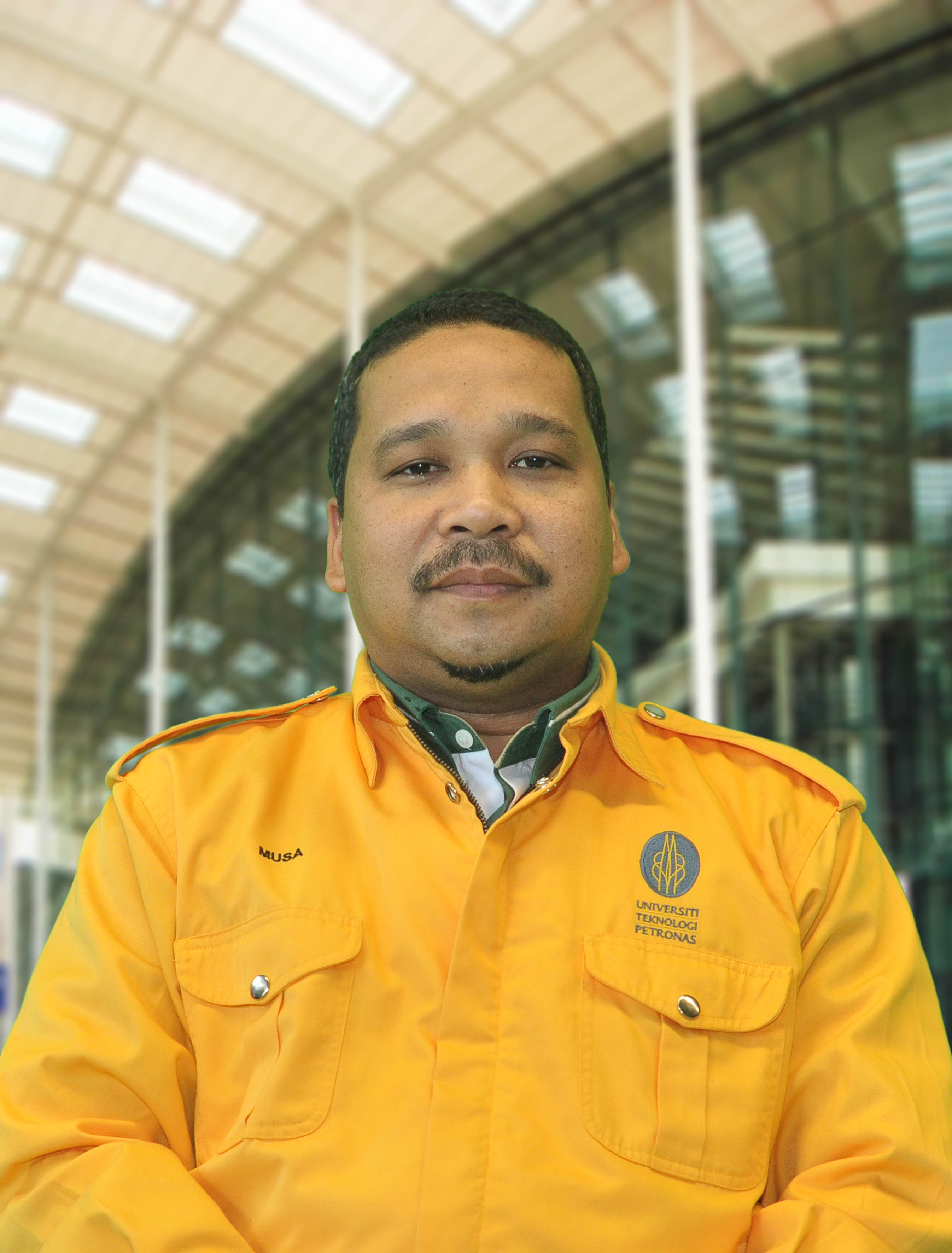
PROGRAM TANGGUNGJAWAB SOSIAL KORPORAT JABATAN PENGURUSAN MAKMAL UNIVERSITI TEKNOLOGI PETRONAS BERSAMA JABATAN PENDIDIKAN NEGERI PERAK DAN KESATUAN SEKERJA KAKITANGAN MAKMAL CAWANGAN PERAK SESI PENGAJARAN DAN PEMBELAJARAN MAKMAL SAINS DAN KEJURUTERAAN TARIKH : 2 OGOS 2023 , RABU MASA : 08:00 HINGGA 17:00 TEMPAT : BLOK 11 DAN MAKMAL, UNIVERSITI TEKNOLOGI PETRONAS AJK PROGRAM Penaung: Ir M Fatimie Irzaq B Khamis Penasihat I: En M Zairi B M Zohaidi Penasihat II: Tc Shaiful Hisham B Hj. Samsudin Ketua Program: Tc Musa B M Yusuf AJK Pendaftaran/Dokumentasi/F&B: Tc Azirawati Bt Aziz Pn Hajah Siti Hawa Bt Tahir AJK Teknikal/Siaraya/Persediaan Lokasi: En Meor Asniwan B Mew Ghazali En Khairul Anwar B Ahmad En M Zaid B Zainuddin AJK HSE/Sekuriti/Pengangkutan/Banner: En Zaaba B Mohammad Ts Suleiman Hakimi B Zainal Abidin En Ahmad Shahrul B Ahmad Juruacara Majlis: Pembaca Doa: Pn Hazniza Bt M Hanif En Isnani B Alias AJK Pengurusan Acara: Pn Hazlin Hazlina Bt Zainun En Mior Rosgiazhar B Mior Sofli Jurugambar Majlis: En Nur Adli B Wook FASILITATOR/PENYAMPAI Tajuk Fasilitator/Penyampai Operasi Makmal En M Zairi B M Zohaidi En M Zaid B Zainuddin Pelaksanaan Aspek HSE & 5S Makmal En M Khairul Anuar B Jamaludin Eksperimen dan Demo Makmal Sains Fizik Tc Saiful Nizam B Ismail En M Adli B M Yusof Eksperimen dan Demo Makmal Sains Kimia Tc M Firdaus B M Hashim ChM Nor Siti Fatimah Bt Arif Shah Tc M Shaharuddin B A Rahman Cik Azriha Bt Anuar En Khairul Afizan B Saidin Eksperimen dan Demo Makmal Kejuruteraan Elektrik & Elektronik En M Zuraimi B Abd Rahman En M Alif Afiq B Ahmad Rahim En Badrunizam B Ni @ A Rani. Pn Noralyza Bt Tamjis Pn Siti Hajjar Bt Mustaffa En Noor Azwan B Ahmad Lawatan ke Kawasan Pengumpulan Satelit Sisa Berjadual Makmal Tc Ridzuan B Abdullah (CePSWaM) Pn Norhayama bt Ramli Pn Rj Intan Shafinaz Bt Rj M Noor
PROGRAM TANGGUNGJAWAB SOSIAL KORPORAT JABATAN PENGURUSAN MAKMAL UNIVERSITI TEKNOLOGI PETRONAS BERSAMA JABATAN PENDIDIKAN NEGERI PERAK DAN KESATUAN SEKERJA KAKITANGAN MAKMAL CAWANGAN PERAK SESI PENGAJARAN DAN PEMBELAJARAN MAKMAL SAINS DAN KEJURUTERAAN TARIKH : 2 OGOS 2023 , RABU MASA : 08:00 HINGGA 17:00 TEMPAT : BLOK 11 DAN MAKMAL, UNIVERSITI TEKNOLOGI PETRONAS Masa Agenda 0800 Ketibaan Para Peserta 0815 Ketibaan Ketua Pegawai Perkhidmatan Sokongan UTP Ketibaan Ketua Penolong Pengarah Kanan , JPN Ketibaan Pengerusi KSKM Cawangan Perak 0820 Taklimat Keselamatan Bacaan Doa Tayangan Video Rasmi LMG 0830 Ucapan Aluan oleh En Syazwan Amarjit Abdullah Ketua Pegawai Perkhidmatan Sokongan UTP 0840 Ucapan oleh Pn Hajah Bainah Bt Ab Dolah Ketua Penolong Pengarah Kanan Matematik & Sains, Sektor Pembelajaran JPN 0850 Pertukaran Cenderamata 0855 Taklimat Program 0900 Sesi 1 Tajuk: Operasi Makmal 0930 Sesi 2 Tajuk: Perlaksanaan Aspek Keselamatan dan 5S Makmal 1000 Sesi Bergambar 1005 Rehat Minum Pagi 1020 - 1255 Sesi 3 & Sesi 4 Tajuk: Aktiviti Pengajaran dan Pembelajaran di Makmal Fizik dan Kimia Lokasi: Blok 19 1300 Rehat Makan Tengahari. 1330 Solat 1430 Sesi 5 Tajuk: Aktiviti Pengajaran dan Pembelajaran di Makmal Kejuruteraan Elektrik & Elektronik. Lokasi: Blok 22 & 23 1630 Lawatan ke Kawasan Pengumpulan Satelit (SAA) Sisa Berjadual Makmal Lokasi: Blok 13 1645 Majlis Penutup ,Sesi Bergambar dan Minum Petang 1700 Bersurai
BIL NAMA KUMP BIL NAMA KUMP 1 NOR AZURA BINTI DAUD 1 1 SITI MARSHITAH BT ISHAK 2 2 NOORFARAHIYAH BINTI KAMARULZAMAN 1 2 NURMURIZ’AIN BINTI MIOR JAFAR 2 3 NOR AZLAN BIN MOHD NOR 1 3 NORHAZIRAH BINTI MOHAMAD YAHAYA 2 4 MOHAMAD YUSRI BIN MD ZABIDI 1 4 MUHAMMAD SAUFI BIN SUKIMIN 2 5 HARTINI BINTI SARPIN 1 5 NATASYA ADILA BINTI AHMAD 2 6 ANUAR AHMAD BIN NAZEER AHMAD 1 6 NOR AZIZAH BINTI REZALI 2 7 NOR LINDA BINTI AHMAD HUSAINI 1 7 SITI NORMARLIANA BINTI MOHD ZAIDI 2 8 AIZAN BINTI AHMAD 1 8 NORHIDA BINTI MOHAMAD SOL 2 9 MOHD SOFI BIN HUSIN 1 9 ROZINA BINTI MOHAMED RAZALI 2 10 SYED JAMAL BIN HJ VEERA SHAIB 1 10 ROHANI BINTI MOHD SAPARDI 2 11 SABRI BIN ABU HANIPAH 1 11 NORMAZFIZAH BT. BADARUDDIN 2 12 NOORULL AZIRAH BINTI MOHAMMAD NOR 1 12 NORZILA BINTI HASSAN 2 BIL NAMA KUMP BIL NAMA KUMP 1 AINUN JAWAHIR BINTI IBRAHIM 3 1 FARAH AZUATI BINTI KHAIRIL AZUAN 4 2 ROZAINI BINTI MUHD ROZKEE 3 2 NOR HASHIMAH BT JUMRI 4 3 NOR ASHIKIN BINTI ABDUL MUTALIB KHAN 3 3 AINULAKMAL BT ABDUL HALIM 4 4 KHALIJAH BINTI REJAB 3 4 MOHD RAHIMI BIN KAMARUDDIN 4 5 NURAIDA BINTI MOHD SALLEH GOH 3 5 MASLIN AP MENAN 4 6 NAZRIN NOR BIN SOHOR 3 6 MAS AYU BT ABDULLAH 4 7 MONA LIZA BT MOHAMAD 3 7 MOHD TARMIZI BIN HAMID 4 8 NOR SYUHADA BT. SURATMAN 3 8 AHMAD RIDZUAN BIN MOHD RODZI 4 9 MASRINA BINTI ABU BAKAR 3 9 NUR FARAH SYAFIQA BINTI ND HARRIS KAMAROSKY 4 10 NOOR FATIN BT YAAKOB 3 10 NURULHIDAYAH BINTI ABDULLAH 4 11 SITI MAISYARAH BT MOHAMED NOR 3 11 NUR NASUHA BINTI SUHAIMI 4 12 MOHAMAD FAIRUL BIN SAIDIN 3 12 SUZANA BINTI ABDUL KADIR 4 13 MOHAMAD ALI BIN OTHMAN 3 13 MOHD YUHAN WAHYUDI BIN ABDUL AZIZ 4 SENARAI NAMA PARA PESERTA MENGIKUT KUMPULAN
TAJUK CH1 CH2 PH1 PH2 EE1 EE2 LOKASI MASA 19-02-13 19-02-08 19-01-06 19-01-09 22-01-15 22-01-02 1015-1050 1 2 3 4 1055-1130 2 3 4 1 1135-1210 3 4 1 2 1215-1250 4 1 2 3 1430-1525 1530-1625 NOTA: CH1 TITRATION USING PHENOLPHTHALEIN CH2 THERMOCHEMISTRY: HEAT OF SOLVATION FOR MAGNESIUM PH1 GRAVITY & FREEFALL PH2 SIMPLE HARMONIC MOTION EE1& EE2 OHM’S LAW & DC CIRCUIT 1&2 3&4 SESI PRAKTIKAL DAN LOKASI MAKMAL
LAMPIRAN RUJUKAN
RUJUKAN UNTUK EKSPERIMEN MAKMAL FIZIK
31/7/2023 1 GRAVITY AND FREEFALL OBJECTIVE At the end of the lab session, we should be able to: • Sketch the velocity against time graph. • Determine the acceleration of an object due to gravity using photogate. 1 2
31/7/2023 2 THEORY When an object is in “free fall”, it means that the only force acting on it is the force of gravity. As an object falls freely, it accelerates. For a falling object near the surface of Earth, the rate of change of velocity is a constant value. This value is the acceleration due to gravity. If you ignore air resistance, a falling ball accelerates as if it is in free fall. You can measure the motion of the falling ball to find the value of the acceleration due to gravity. Based on the equation of motion with constant acceleration: (1.1) neglecting air resistance, an object falls a distance proportional to the square of the time, (see Figure 1.1). From Figure 1.1, the object is at position x1 at some time t1. At time t2, the object is at location x2. The average speed v12 for this object as it travels between these two points will be (1.2) Similarly, the average speed v23 during the next time interval (that is, between the instants t2 and t3) is (1.3) The instantaneous speed at exactly the midpoint of the time interval is the average speed. Even if the acceleration were not uniform, this would be a close approximation if the interval of time were short. So v23 would occur at the midpoint of the time interval given by (1.4) When average speed is plotted against time, the acceleration of the falling object can be determined from the slope of the speed-time graph. A “Picket Fence” is a clear plastic strip with uniformly spaced opaque bands. When it is dropped through a Photogate, each opaque band on the ‘Picket Fence’ blocks the Photogate beam and the time from one blockage to the next becomes increasingly shorter. Knowing the distance between the leading edge of each opaque band, the DataStudio program records the time when each band blocks the beam. 3 4
31/7/2023 3 APPARATUS • Photogate/Pulley System 1 unit • Picket Fence (ME-9377A) 1 unit • Universal Table Clamp 1 unit PROCEDURE 1. Taking Data a. Make a table and put the Block Times in the first column. Then create a user entered data set named “Δt” with units of seconds. (Remember that you can get a Δ in Capstone by right-clicking where you are typing.) Create a new column and create another user-entered data set called “Average Time” with units of seconds. Create another column with another user-entered data set called “v=Δx/Δt” with units of m/s. b. Start recording data, then drop the Picket Fence through the Photogate. Stop recording data c. If the Picket Fence hits the Photogate, or if it rotates too much, you should take another run. You should have seven entries in the data table. These are the times that each of the seven bands on the Picket Fence broke the Photogate beam. 5 6
31/7/2023 4 RESULTS 1. Set up your Table display so it shows the values of time and position. 2. Plot a graph of distance versus time. 3. Calculate the average speed for each of the intervals. 4. Plot a graph of average speed versus time. Thank You Through Get Connected platform, you can be in the know about our latest technologies, ongoing events, as well as a great deal of other opportunities. Please scan the QR code. 7 8
31/7/2023 5 SIMPLE HARMONIC OSCILLATION OBJECTIVE At the end of the lab session, students should be able to: • Determine the spring constant of the spring using the period of the oscillation. 9 10
31/7/2023 6 THEORY For an object with mass m attached to a single spring, the theoretical period of oscillation is given by: where T is the time for one complete back-and-forth motion (i.e., one cycle), m is the mass of the object that is oscillating, and k is the spring constant. APPARATUS • Motion Sensor 1 unit • Economy Force Sensor 1 unit • Base and Support Rod 1 unit • Ruler 1 unit • Mass hanger 1 unit • Spring, k ~ 2 - 4 N/m 1 unit • Masses, 10 g (1), 20 (2) PROCEDURE Part A: Spring Constant – Oscillation 1. Set up the equipment as shown. 2. Using a support rod, suspend the spring so that it can move freely up-and-down. 3. Given that weight of the mass hanger is 5 g, hang the mass hanger with a 10 g mass onto the spring. 4. Pull the mass hanger down slightly and release it to create small oscillations (10 seconds) 5. Record the oscillation by clicking on “Start” button in the DataStudio and stop data recording by clicking the “Stop” button. 6. Record the period, T from the Position vs Time Graph in the Data Table. 7. Repeat the data recording process for 20 g, 30 g, 40 g and 50g. 11 12
31/7/2023 7 RESULTS RESULTS 1. Record all the data in the Data Table. 2. Does the period of oscillation increase of decrease as the mass is increased? 3. Does the amplitude of oscillation affect the period? 4. Plot the Period vs √ on excel 5. Determine the value of kB given that gradient of “period (T) vs √” graph plot is √ 6. If the theoretical value of spring constant is 2 N/m, calculate the percentage error. DATA TABLE 13 14
31/7/2023 8 Thank You Through Get Connected platform, you can be in the know about our latest technologies, ongoing events, as well as a great deal of other opportunities. Please scan the QR code. 15
RUJUKAN UNTUK EKSPERIMEN MAKMAL KIMIA
30/7/2023 1 Titration using phenolphthalein indicator (Laboratory 19-02-13) OBJECTIVE At the end of the lab session, we should be able: • Familiarization with the foundation chemistry laboratory activity with a good safety practice. • To determine the concentration of the acidic solution by titrating it with a basic solution of known concentration. 1 2
30/7/2023 2 THEORY Titration is a laboratory technique used to determine the concentration of a solution using another solution with a known concentration. One of the solutions involved in a titration is used as a standard solution. A standard solution of titrant in a burette is gradually applied to react with an analyte with an unknown concentration in an Erlenmeyer flask. The most common standard solutions used in acid-base titration . An acid-base titration is an experimental procedure used to determined the unknown concentration of an acid or base by precisely neutralizing it with an acid or base of known concentration. Solutions of sodium hydroxide are commonly used in titration analysis of samples containing an acidic solute. The standardized NaOH becomes the secondary solution and can then be used to determine the concentration of other acids. # Phenolphthalein is the indicator used in this experiment. Phenolphthalein is colorless in acidic solutions and turns pink in alkaline solutions. Figure 1: Phenolphthalein indicator APPARATUS • 50mL Burette with stand • Measuring cylinder • Funnel • 50mL conical flasks with stopper • 100 mL conical flasks • 250mL volumetric flasks REAGENTS • Sodium hydroxide solution • Sample of titration • Phenolphthalein indicator 3 4
30/7/2023 3 Figure 2: Experimental set-up DIAGRAM PROCEDURE 1. Perform the experimental set up according to Figure 1. 2. Take 10mL of sample from 50mL conical flask with stopper by using measuring cylinder and put into 100mL of conical flask. 3. Add 2-3 drops of Phenolphthalein indicator solution. 4. Fill the 50mL of burette with sodium hydroxide solution by using funnel. 5. Then, start to titrate the solution until a pink colour appears. 5 6
30/7/2023 4 REFERENCE Figure 3: Acid and base colour chart of indicator Thank You Through Get Connected platform, you can be in the know about our latest technologies, ongoing events, as well as a great deal of other opportunities. Please scan the QR code. 7 8
30/7/2023 5 THERMOCHEMISTRY: HEAT OF SOLVATION FOR MAGNESIUM (Laboratory 19-02-08) LAB SAFETY INSTRUCTION 9 10
30/7/2023 6 OBJECTIVE • To demonstrate technology used by LMG in enhancing the efficiency of chemistry lab session. • To conduct an experiment involving chemical thermodynamic theory conducted in LMG Chemistry Lab. THEORY Thermochemistry is an essential sub-theme in thermodynamics, as it helps chemists to understand the interrelation between energy absorbed or released during chemical reactions. Study on heat of solvation (enthalpy of solvation) is one of the prime examples of thermochemistry, as it associates the changes in the energy during chemical reaction involving dissolution of sample in a solvent while the pressure is kept constant. 11 12
30/7/2023 7 INTRODUCTION In this module, magnesium ribbon will be dissolved in different solvents and the temperature change during the experiment will be measured by using temperature probe tethered to Vernier LabQuest. During the experiment, participants can closely monitor the temperature changes during chemical reactions through the graphical interface of LabQuest. Furthermore, highly accurate changes in temperature (ΔT) of the solvent can be obtained through the utilization of Vernier LabQuest. MATERIALS APPARATUS CHEMICAL 1.Vernier LabQuest 1.Distilled water (H2O) 2.Temperature probe 2.1M Sodium hydroxide (NaOH) 3.Hotplate and stirrer 3.1M Hydrochloric acid (HCl) 4.1M Sulfuric acid (H2 SO4 4.Utility clamp ) 5.150ml beaker 5.Magnesium ribbon 6.100 ml measuring cylinder 7.Magnetic stir bar 13 14
30/7/2023 8 EXPERIMENTAL SETUP PROCEDURE 1.Set up the Vernier LabQuest for data collection. 2. Measure 100 mL of solvent (1 M HCl/ 1 M H2 SO4 / H2O/ 1 M NaOH) by using a measuring cylinder and transfer the related solvent into a beaker. A small magnetic stir bar is also added into the beaker. CAUTION: Handle the acid and base solutions with care. It can cause painful burns if it comes in contact with the skin. 3. Place the temperature probe into the beaker. Set the stirring rate to 1.5 rpm. 4. Weight out about 0.5g of magnesium ribbon. 5. Start the temperature reading (t=0s). At 30 seconds, add the magnesium ribbon to the solvent. 6. Monitor until the temperature stabilize. CAUTION: Do not breathe the vapors produced in the reaction. H HCl 2 NaOH H2O SO4 Rate (Sample/ sec) 1 1 1 1 Duration (second) 300 300 300 300 Stirring rate (rpm) 1.5 1.5 1.5 1.5 15 16
30/7/2023 9 OBSERVATION H HCl 2 NaOH H2O SO4 Temperature increase Yes / No Yes / No Yes / No Yes / No Gas formation (bubble) Yes / No Yes / No Yes / No Yes / No Nil/ Low/ Medium / High Nil/ Low/ Medium / High Nil/ Low/ Medium / High Nil/ Low/ Medium / High Reaction rate (temperature gradient) Completion of reaction Yes / No Yes / No Yes / No Yes / No within 300 second Initial temperature (˚C) Final temperature (˚C) Temperature difference, ΔT (˚C) Thank You Through Get Connected platform, you can be in the know about our latest technologies, ongoing events, as well as a great deal of other opportunities. Please scan the QR code. 17 18
RUJUKAN UNTUK EKSPERIMEN MAKMAL ELEKTRIK & ELEKTRONIK
31/7/2023 1 Introductory of ee laboratory equipment, ohm’s law & dc circuit OBJECTIVE To familiarize students with: Identify and investigate the basic functions of electronics lab equipment. Study the usage of breadboard & how to generate simple circuit. Ohm’s Law, which is the fundamental law for electrical circuits. Measurement of resistance values. Series and parallel DC circuits. 1 2
31/7/2023 2 LAB EQUIPMENT 1. Digital Multimeter 2. DC Power Supply 3. Digital Oscilloscope 4. Function Generator 5. Breadboard DIGITAL MULTIMETER (DMM) The DMM used in the lab is manufactured by FLUKE. It is handy in making basic electrical measurements including voltage, current, resistance, and continuity. To turn ON the DMM, turn the rotary switch to right until you get the right parameter to measure. Other measurement functions are accessed from the front panel buttons and many functions are available by pressing the yellow key. 3 4
31/7/2023 3 DMM Measuring method Measuring AC & DC voltage Measuring Resistance value Testing Continuity Measuring AC or DC current 1. Turn Power OFF 2. Break circuit 3. Insert DMM in series 4. Turn Power ON DC POWER SUPPLY Like a battery, a DC power supply provides a constant voltage for powering electronic circuits. But, unlike a battery, the power supply will provide continuous power if it is connected to a wall/table outlet. 5 6
31/7/2023 4 DIGITAL OSCILLOSCOPE Oscilloscope test and display voltage signals as waveforms, visual representations of the variation of voltage over time. The signals are plotted on a graph, which shows how the signal changes. The vertical (Y) access represents the voltage measurement, and the horizontal (X) axis represents time. Calibrating your oscilloscope assures you that your measurements are accurate within the specification limits that led you to select the instrument in the first place. FUNCTION GENERATOR The function generator series are stable low distortion instruments which generate signals in the frequency range up to 5MHz. A function generator is electronic test equipment that generates standard waveforms, such as sine, square, ramp, or sawtooth waves, to a device under test (DUT). In circuit design and boards, testing often requires a controllable signal to simulate regular operation. 7 8
31/7/2023 5 BREADBOARD A breadboard is used for building temporary circuits. It allows components to be removed and replaced easily. It is useful to the person who wants to build a circuit to demonstrate its action, then to reuse the components in another circuit. Ohm’s Law theoretical Ohm’s Law states that in resistive circuit, when the resistance is kept constant, the current through the resistor is directly proportional to the voltage across the resistor. It is written as V = IR. Thus, if voltage is plotted as a function of the current, an ohmic resistor would yield a linear plot with slope equal to the resistance value. 9 10
31/7/2023 6 RESISTORS Resistors are used to resist the flow of current. When resistor is placed in a circuit, the current flow decreases when current passes through the resistor. They are available in many different forms and types. In this figure, the resistor has 4 color bands. You may encounter the 5 color bands or 6 color bands resistors, but this experiment uses the 4 color-band resistors. The first two bands indicate the precision values, the third band indicates the power of ten applied and the fourth band indicates the tolerance. Resistor 20 + 10%. The 1st band is red, 2nd band is black, 3rd band is black and 4th band is silver. Exercise 1 Equipment & apparatus 1. DC Power Supply 2. Digital Multimeter (DMM) 3. Resistor 2kW 4. Breadboard Series DC Circuit In series circuit, the current is the same at all points in the loop. We can use an Ohm’s law to determine the total current by dividing the voltage source by the total resistance in series. Procedure 1. Use DMM to measure the 2kW resistor. Measured resistance value = _________ 2. Build the circuit as figure 1. Use 2kW resistor. 3. Test the circuit from 0V ~ 12V. 4. Record the value. Figure 1 11 12
31/7/2023 7 Exercise 2 Equipment & apparatus 1. DC Power Supply 2. Digital Multimeter (DMM) 3. Resistor 1kW, 2kW, 3kW 4. Breadboard Procedure 1. Build the circuit as figure 2 with V = 15V, R₁ = 1kΩ, R₂ = 2kΩ and R₃ = 3kΩ. Calculate the Rₜ = __________ 2. Measure the current at points A, B and C. Record the value. 3. Measure the voltage across R₁, R₂ and R₃. Record the value. V Figure 2 Exercise 3 Equipment & apparatus 1. DC Power Supply 2. Digital Multimeter (DMM) 3. Resistor 1kW, 3kW 4. Breadboard Parallel DC Circuit In parallel circuit, the voltage is the same across all components because they have the same common nodes. The total current can be found by dividing the voltage source by the equivalent parallel resistance. Procedure 1. Build the circuit as figure 3. Set the voltage to 20v, R₁=1kΩ and R₂=3kΩ. Calculate the Rₜ = ____________ 2. Measures the voltages across the DC supply & across both resistors. Record the value. 3. Measure the total current, I₁ and I₂ through each resistor using the ammeter. Record the value. V Figure 3 13 14
31/7/2023 8 Exercise 4 Equipment : 1. Digital Oscilloscope 2. Function Generator Draw the following waveforms as you display it on the oscilloscope. Thank You Through Get Connected platform, you can be in the know about our latest technologies, ongoing events, as well as a great deal of other opportunities. Please scan the QR code. 15 16
RUJUKAN UNTUK SESI LAWATAN KE KAWASAN PENGUMPULAN SATELIT (SAA) SISA BERJADUAL DI BLOK 13
28/7/2023 1 UTP Satellite accumulation area (saa) for Scheduled Waste Introduction • Scheduled waste Satellite Accumulation Area (SAA) is the designated area to accumulate scheduled waste produced by teaching & research activities in UTP laboratories. The location is next to the waste generator area before transferring to Scheduled Wastes (SW) store. 1 2
28/7/2023 2 Regulations and Guidelines Environmental Quality (Scheduled Wastes) Regulations 2005 STORAGE AREA INSPECTION (Guidelines for Packaging, Labelling and Storage of Scheduled Wastes In Malaysia) • Inspection of the stored containers shall be carried out on weekly basis to avoid any mishap and be kept in a logbook for reference. • Waste generator and handler shall prepare a standard inspection checklist for the purpose of regular inspection. • Inspection checklist shall be kept and updated from time to time. • Upon inspection, immediate action shall be taken if any problem is detected. • The waste generators shall prepare an accurate and up to date inventory of scheduled wastes as stipulated under Regulation 11 of the Environmental Quality (Scheduled Wastes) Regulations 2005. • Scheduled waste accumulated at the SAA must not be stored > 180 days or exceed the capacity limits and shall be immediately transferred to the scheduled waste main store within three (3) working days once reaches its capacity limits Process Flow 3 4
28/7/2023 3 Scheduled Waste Storage Inspection Checklist Weekly © Scheduled Waste Inventory Monthly © 5 6
28/7/2023 4 Scheduled Waste Declaration Form Handling Of Waste • Personal protection equipment: -Gloves, Goggles, Face shield etc. • Procedures/Precaution in handling, packaging, transporting and storage. • Appropriated label -Labels for the containers • Recommended method of disposal. 7 8
28/7/2023 5 Scheduled Wastes Code Satellite Accumulation Areas (SAA) Location & PIC Location PIC 1 PIC 2 Block 04-00-09 Khairul Afizan bin Saidin Zaaba bin Mohammad Tc. Raja Intan Shafinaz binti Raja Mohd Noor Block 13-00-13 Norhayama binti Ramli Block 22-00-02 Tc. M Shaharuddin bin A Rahman M Zuraimi bin Rahman Block J2-25 Suhaila Binti Meor Hussin Nur Ain Binti Zafri Block N1-MCRL-02 Ahmad Shahrul bin Ahmad Tc. Khairul Anwar Ahmad Block P1 Meor Asniwan bin Mew Ghazali Tc. Musa bin Mohd Yusuf R&D, Block C Tc. Mior Rosgiazhar Bin Mior Sofli Ts. Suleiman Hakimi bin Zainal Abidin Block 12, Ground Floor Tc. Iswadi bin Radzali Tc. Hilmayeni binti Suardi 9 10
28/7/2023 6 Thank You Through Get Connected platform, you can be in the know about our latest technologies, ongoing events, as well as a great deal of other opportunities. Please scan the QR code. 11 12
PENGHARGAAN PIHAK AHLI JAWATANKUASA PROGRAM CSR MENGUCAPKAN RIBUAN TERIMA KASIH KEPADA SEMUA PESERTA YANG TELAH MENYERTAI PROGRAM CSR LMG, UTP BERSAMA JPN & KSKM PADA KALI INI. SEMOGA ANDA SEMUA MEMPEROLEHI MANFAAT DARIPADA PROGRAM KAMI INI. SEMOGA JUMPA LAGI SEKIAN TERIMA KASIH. ‘Terma Penafian’ Anda tidak dibenarkan menyalin dan menyiarkan dalam apa-apa bentuk medium, menghantar, mengubahsuai atau mengubah dalam apa cara sekalipun kandungan-kandungan yang ada dalam buku program ini. Kebenaran bertulis perlu diminta jika ingin menggunakan apa-apa kandungan daripada manamana bahagian buku program ini. Pihak LMG, UTP tidak bertanggungjawab jika timbul apa-apa masalah daripada aktiviti yang melibatkan mana-mana pihak yang mengambil isi kandungan buku program ini tanpa kebenaran bertulis.