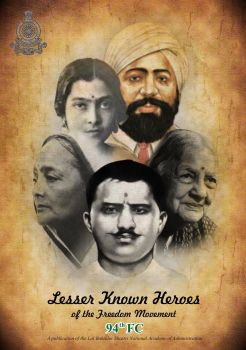
Lesser Known Heroes of the freedom movement
From the Desk of the Director
What is History? Asked EH Carr in 1961
Well, in addition to what he said about the bias of historians, science, morality, individuals and society, it has to be understood that perception of history changes with time . In the fourth BCE , the Sanskrit litterateur Bhasha , who wrote Madhyamavyayoga based on the years of Pandavas in exile, and Herodotus who wrote Histories were in a way contemporary historians writing about what they felt were significant events of their times . Right till the mediaeval times , all across the world , history was the story of kings and dynasties , usually written in the language of the court – as for example Rajatarangini by Kalhana – the story of the kings of Kashmir in Sanskrit and a few centuries later , the beauty of Kashmir , and the conquest of Mughals comes to the fore in the highly Persianized Tuzk-e Jahangiri.
Not until Carlyle, who wrote of Odin, Prophet Mohammed, Galileo and Shakespeare as men who shaped history were people beyond the charmed circle of royalty accorded the honour of being relevant to history, Then we had Toynbee who discussed the cycles of history , the school of historical materialism , the colonial and post-colonial construction of history , and now the subaltern and feminist discourses. And so one can say, that each generation must produce its own history by reinterpreting facts, government records, oral histories, anecdotes and by connecting the dots. This exploration becomes even more illuminative when we contemplate the panorama of epic events that culminated in the independence of our nation, we are likely to think that only images, events and names that have come to us through textbooks and the media make up the saga of our freedom movement . We are likely to have allowed these emblems of our past to define the contours and substance of what the Freedom Movement means to us. these carriers of meaning have probably settled like neat layers of precious silt into the recesses of our sub conscious . The History Project by my colleagues Monika Dhami and Gauri Parasher Joshi was an attempt to disrupt this complacency that afflicts our understanding of the defining moments of our collective past.
We read every day that we live in an age of disruptive technologies. Well, this endeavour is, in some ways a disruption of memory, a pricking up of the particles of silt so that the deceptive clarity of water would now give the viewer myriad particles of silt to view and to comprehend. Histories of great nations can hardly be thought of as flowing through linear canals, they are meant to be explored in the very detail that disperses through their rocky and meandering course, giving them form, taking them to their origin and end.
The History Project is not, however, a general exploration of all that came into being and to the fore during our struggle for freedom. I am reminded of Shakespeare’s Hamlet, of whom Polonius says, ‘Though this be madness, there is method in’t’. If every exploration warrants a degree of ‘madness’, even if for the love of the subject that one wishes to delve into, then it is essential that ‘method’ be found so that there is a trajectory, a course, and that glimpse of treasure at the end of the journey, that is its own reward. So, we nudged the young minds to delve deeper into the syllables in the hidden names, to the stamp of daredevilry in the silence of forgotten explosions and to present the invaluable contribution of the women and men who neither claimed nor were bestowed with recognition due to them. They were the foot- soldiers of the cause of freedom, of self-respect, the sparks without which the flame of freedom might well have waned for lack of energy. Theirs were the necessary but invisible sacrifices that the exacting prize of freedom demanded.
Quite like the rigor of History, The History Project will not end with this bringing together of the efforts of Officer Trainees of the 94th Foundation Course. I envision that it will light many alternatives paths to comprehending the intricacies of the past that continue to form our present and unravel into the many futures that await our great nation.