Alexander A. Parise
An open letter to those
who have been bitten
and are thinking about
scratching the itch
Dear aviator...
© Alexander Andrew Parise 2020
Foreword
Dear aviator,
It is very likely that you are reading the wrong book.
If you are reading this thinking that it will give you an idea of how to get through
training and how to pass your exams and flight tests and get yourself into a paying
job as quickly as possible then let me set the record straight: I am a freshly minted
commercial pilot with two years’ experience in aviation. If you think that that
makes me somewhat of an expert you definitely need to do some more research.
Seriously though, there are plenty of very good books, web series, blogs and vlogs
and fora managed by legitimate experts that you should read and watch; I’ll include
a list of some of the ones I use in the reference section.
So “what is the purpose of this guide?” I hear you ask. Its purpose is twofold: on
one hand it is cathartic. It is designed as a tool for myself to debrief and
decompress these past two years in order to gain a fresh perspective of my journey
from zero experience to a Commercial Pilot’s Licence with Multi Engine Class
Rating. In turn I am hoping that by doing this I will be able to gain some insight
into what I’ll be doing next as I progress towards finding a place within the
industry. As a by-product of this self-analysis (some might say over-analysis) I am
also hoping to create a narrative which may prove useful to someone who, like me,
became interested later in life in engaging with some sort of career change in order
to replace the deck of cards they were dealt and wishing to challenge themselves
with something new and unexpected such as aviation. The usefulness of this guide
is not inherent in its content; it is not intended to contain advice or tips and tricks;
those are all things that are meant to be discovered during the journey, including
the inevitable pitfalls and disappointments. The journey, as it were, would be
incomplete if everything flowed flawlessly and there were no negative experiences.
Hence, its usefulness lies in the short period between your decision to look into
pilot training and the choosing of your flight school, while your feet are still firmly
planted on the ground but your mind is starting to test the fantasy of flight. The
content stems from the mental processes that I found myself going through and
which might inspire similar - or completely different - processes in the mind of you
the reader. As far as I’m concerned, if these pages will inspire you to stop a while
and think about where you are in life, where you would like to go and what you are
prepared to do to get there, then I will consider it a success.
In broader terms, rather than an account of the course as the progressive
acquisition of proficiency in a technical skill, it is an attempt to acknowledge
aviation training as a deeply human experience; it has a lot more to do with
“feelings” and “sensations” than it has to do with hard facts and technical know-
how. I would like to show in what way the human spirit can guide you through this
extremely rewarding path.
1
I’d like to think that if I could send this booklet into the past to myself, I would find
it useful. Everyone will tell you that before you enrol in a flight training course you
should "do your research". But as a novice you don't even know what questions to
ask and to whom! I’m not saying that this booklet solves that but it might just give
you a couple of road signs to guide you in the right direction to the appropriate
information booth.
I collected my thoughts in several paragraphs and laid them out in what I hope is a
logical sequence. However, you should be able to read each single paragraph in a
stand alone fashion, based on what topic you may be more interested in.
Disclaimer
At the expense of seeming pedantic, this is NOT a guide on how to become a pilot
nor on how to choose a flight school. I AM NOT a flight instructor (yet) and the
thoughts herein contained are borne out of MY OWN limited experience and reflect
MY journey. There are many very different pathways you can follow to become a
pilot, some quicker than others, some cheaper than others. I believe there is no
“perfect” pathway. It is up to each of us to select, or better yet, construct the best
one based on the information we have. Among other things, this booklet is meant to
give you some added information that you might not otherwise have at the onset of
your journey.
The sources I used in writing these paragraphs are of three basic types: rummaging
through my own memories, feelings and sensations; going back to the notes and
considerations I jotted down after each theory session, after each training and solo
flight; chatting with my former course mates who, through the wringer of training,
have now become great friends and colleagues.
Lastly, I live and am writing in Australia. Whereas aviation is, almost by definition,
an international venture, General Aviation (GA) relies on local rules and
regulations. It is generally accepted that these rules are very similar around the
world but this should not be taken for granted. I am referencing MY local rules and
regulations and they are valid here and as of this date. Things may work more or
less differently elsewhere.
2
Who was I?
In order for any of this to make sense, it is important for you, the reader, to have
an idea who is talking to you and what his background is. Otherwise there is
nothing for you to latch on to. So… who was I?
I use the past tense because I am a different person today than what I was when I
started this journey. Aviation has this knack for changing people; for changing
them profoundly and in profoundly different ways: arrogant people become humble;
shy people discover themselves as being braver than they ever thought possible;
leaders become listeners, etc… and this should come as no surprise: aviation is the
art of adaptation to constantly changing conditions and circumstances so in the
end it is those who learn to change that are the ones who come out as successful
aviators at the other end.
In June of 2017 I had just turned 38 and my partner convinced me to gift myself a
three-flight “introduction” package at a local flight school. She knew of my interest
in flying and I had not been reticent in mentioning that I would have liked to try. At
the same time, though, I was also asking myself what the point was. “I’m going to
spend 600 dollars for something that is not going to take me anywhere. It’s not like
I’m going to actually get into training right? I can’t afford aviation as a hobby and I
certainly can’t afford the training necessary to get to professional standards, right?”
Moreover, I was under the impression that I was too old. But let’s get into some
specifics.
At the time I had been working for just over four years in a full time humble
administrative position making a steady living wage. The position could be termed
as “cushy” as I had no major responsibilities and could rely on a repetitive and
predictable schedule. I was relatively certain that unless some major upheaval took
place, it was a job I could have kept indefinitely as over those previous years I had
made myself somewhat of the mister fixit for all those small little interruptions
(mostly IT based) that can stop the inner workings of that type of operation.
However, it was also a dead-end job since I was answering directly to my
department manager and had no prospect of getting into a managerial position -
the business was a not-for-profit organisation and those top-end positions were for
the most part assigned based on political prerequisites.
So there I was, wondering if at 38 I was at the apex of my professional life, taking
enrolments for language courses, helping my middle aged colleagues retrieve
unsaved word documents and assisting my manager in unfreezing his computer…
serving wine and washing dishes during public events… setting up exhibitions…
maintaining projectors for our lessons… you get the idea.
I was dreading that prospect with all my heart and had been looking for other job
opportunities over the previous 18 months but, unsurprisingly, had had very little
luck.
3
All of this was contributing to that malady that most of my friends and family were
defining as a mid-life crisis. Obviously I never considered it as such. The decision to
enrol in this 2-year course was dictated out of a latent passion for aviation which
had been an on-again off-again affair since I was 10 years old, and out of the
acknowledgement that this would have been my last real chance at taking a stab at
doing something really special and beautiful and at having a chance of making it
into a profession.
Thus, the decision was made to initiate a profound change in my life, a change not
only in the hand of cards I was dealt, but in the deck and the game entirely.
Thus, an archaeologist, a teacher and a musician decided that it was time for him
to follow a boyhood dream and become a professional pilot.
The bug bites
So, where did the passion come from?
I was lucky enough to travel by plane with my family since my very early childhood
due to my father’s job requiring frequent international travel. The airport and all its
associated sounds and smells have always been familiar to me. Driving there in the
early hours of the morning, checking in, walking through duty free, grabbing
something to read, going through security and waiting at the gate whilst watching
these enormous incredible machines through the large terminal windows. By age 8
I knew my 747s from my DC10s. I remember going to see the flight deck a couple of
times during the trip, at a time when that sort of thing was still possible.
But I wouldn’t say I had been bitten just yet.
I believe the point of no return was crossed a few years later when my family and I
were living in the United States close to an Air Force base and we constantly had
F15s and F16s flying overhead. Every few months the base would have an open day
or an air show day and my dad would invariably take me there. During the same
period, we would go to the local radio-controlled model airplane field and watch
these scale marvels zip around the sky.
My parents began to feed my growing interest with books which included full-
colour technical publications of military and commercial aircraft. My mum was
nurturing a more historical side of things and gifted me books on the history of
aviation and to this day it is a subject I study regularly and eagerly. It was also
mum who purchased my first “how-to-fly” book at age 12. It was an Italian manual
on how to operate ultralights. That’s where I got my first taste of aviation
definitions and technical language. That’s where I learned about the four forces, the
main instruments and how they worked, the basics of aircraft systems. I’d say that
the peak of my early interest in aviation was between the age of 9 and 16. During
that period my dad and I started looking at the feasibility of getting a licence
together. I remember he was considering buying a kit plane in co-ownership with a
family friend who already had a private pilot’s licence and flew out of the local
4
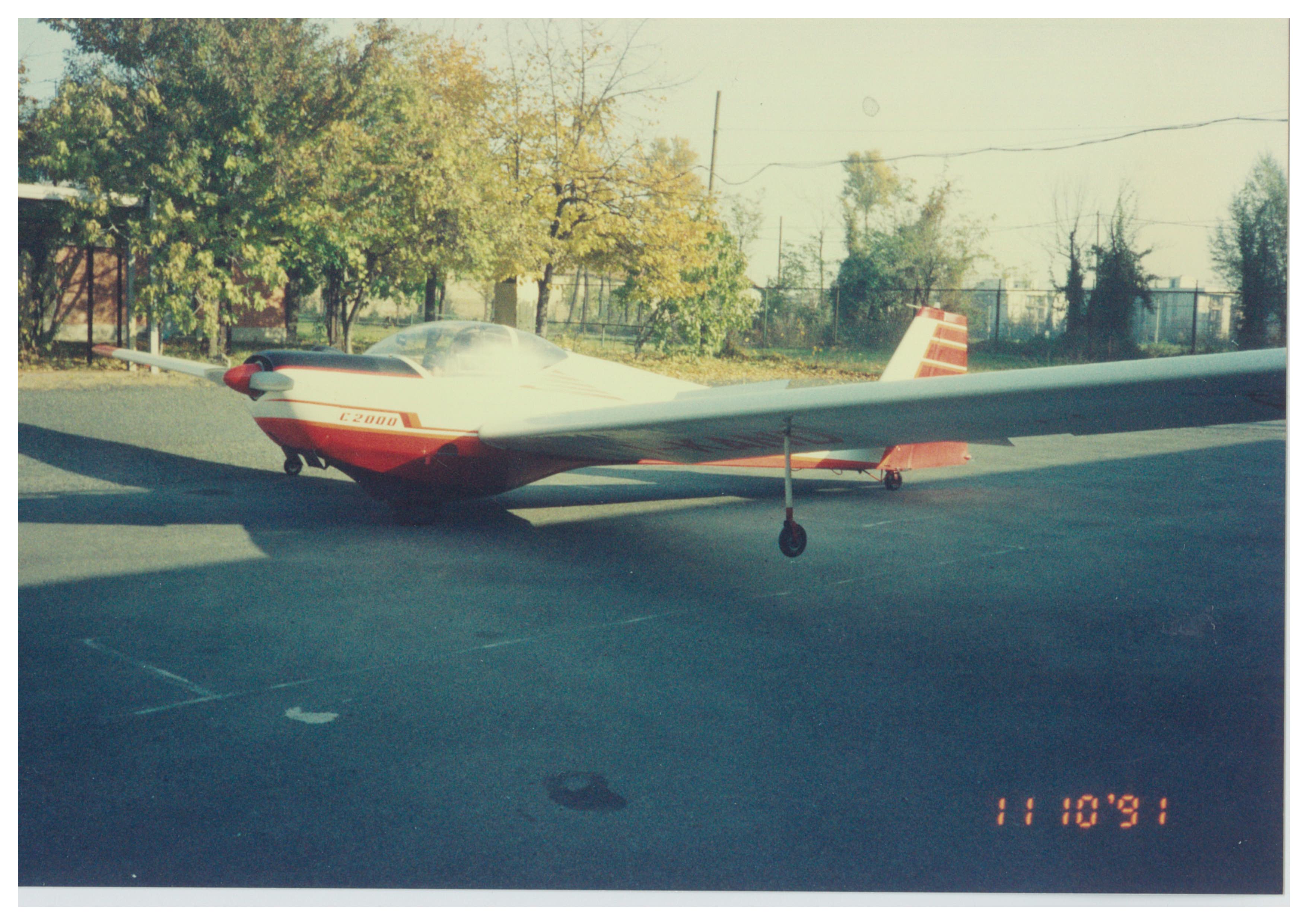
aeroclub in northern Italy; it was with him that I went for my first flight in a small
single engine aircraft, a German-built Scheibe SF-25 Falke motor-glider. But that
was just about when reality started to rear its ugly head. The cost for earning a
licence in Italy was (and still is) prohibitive: aviation in Italy is a pastime for the
wealthy and professional positions within aviation were (and still are) usually
reserved for the ex-military. That, together with puberty, was what caused my
interest in aviation to start to sputter and go dormant. My interest shifted to other
things as I suppose is normal for a teenager. I still occasionally leafed through my
progressively out-dated books and I watched documentaries, but most of my
remaining interest was mostly directed at the history and development of aviation -
a sign that I was starting to look more and more often to the past, which would feed
my academic study of archaeology. Later in life I developed an ongoing layman’s
interest in the space race and astronautics and once every few years, when reading
about the test pilots of the 1950s and 1960s, the itch would start to surge again. I
would then forcibly quash that renewed excitement as I knew that I simply was in
no position to be able to satisfy it, not even as a hobby. That was probably why I
took so much pleasure in building and painting model aircraft, as a way to keep the
hunger at bay. Like everyone, I had my favourites and I kept alternating between
the - at the time - latest generation fighters (F-14 and F-16) and those splendid
WW2 machines such as the B-17, Spitfire and P-51.
The money
“Why did you wait until your late 30s to start training?”
It was mentioned before but let’s drive the point home: learning to fly is very
expensive. As you can imagine this severely limits the ways you can go about it.
- The lucky ones are those who are wealthy and can train on their own time,
at their own pace and not worry about money being siphoned out of their
wallet at an astonishing rate. These are the ones who can then purchase
their own aircraft and simply fly for the pure enjoyment of it; I, and most of
the fellow pilots I have become acquainted with, are not members of this elite
group;
- Next, you have the pathway that most pilots have undertaken since the
earliest days of aviation. Your regular person who started training at a young
age, perhaps with some help from family and who invested every last penny
earned into aviation, living off of noodle rations and taking a flight lesson
whenever they had collected enough money. They also self studied for the
written exam, perhaps attending a ground-school course for the more
demanding topics. This obviously can have an impact on the time it takes
and the efficiency and effectiveness of training: if you can afford one flight
per week, you’ll do fine; but if you can only afford one flight a month, it will
take more overall flights to become proficient as it will take more flight hours
to consolidate your skills. The general understanding is that these pilots are
more skilled as they had a vested interest in getting as much out of their
flights and instruction time since they were paying for it one penny at a time.
5
These are also the ones who are somewhat critical of pilots who trained
using any other method;
- More recently some large airlines have activated cadet programs to train the
next generation of their own pilots. These are also hugely expensive, are
usually age restricted and are run full time on very demanding deadlines.
When I was younger and had started looking into aviation, the “money” issue was
what kept me away. Both as a kid and later as a young adult I simply could not
afford the cost of training. As heart-breaking as it was, I could not conjure money
out of thin air.
Later in life, when I perhaps could have looked into full time funded courses, I
couldn’t afford to stop earning a salary for 18-24 months.
That was when I was made aware of a fourth option:
I was fortunate enough at the time to live in Australia, where under certain
circumstances aviation training can be government funded.
In short, this means that the government will front the cash necessary for CPL
flight training (about $80,000) provided that:
a) I then repay the loan through my taxes;
b) I follow the school syllabus;
c) I perform within certain standards and complete the various study units in
accordance with the established deadlines.
Additionally, there was one school - and only one in my vicinity - which offered this
course on a part time basis: 2 three-hour evenings of classroom instruction and 2
planned flight days per week over a two-year period. These were conditions that I
could afford.
However this option was a relatively new thing and, as previously mentioned, to
this day there is no shortage of snarky comments from pilots who trained in the
more traditional way of self-funding who are very easy to quip that “your
government-funded licence doesn’t hold a candle to my self-funded licence” or “it
was better when people actually had to make a sacrifice or two to get their licence”.
I’m not one to listen to this type of talk. This should be clear… if not for the
government funding program, I would not have been able to get any type of licence
- let alone a CPL - and I alone am aware of the sacrifices that I made and that I
imposed on my family… I believe sacrifices and effort should not be calculated
exclusively on the monetary criterion.
I do appreciate, though, that when you are not directly spending your own money,
it can be easy to become complacent and not put in the appropriate effort,
especially in studying and home preparation and planning; but I believe that
speaks more to the person in general than to the kind of pilot that will come out at
the other end.
The main takeaway of this is that today there are several options for anyone to
learn to become a professional pilot; the lack of pocket money in itself is no longer a
reason not to investigate the option.
6
Who shouldn’t be a pilot
In order to start pilot training you don’t need to know high-level maths and
physics: basic arithmetic and geometry will suffice; you don’t need to be the
embodiment of fitness: as long as you can hold a class 1 or class 2 medical you
should be fine; you don’t need to know anything about aviation in general: that is,
after all, why you’re undertaking the course.
In my opinion the “only” prerequisites lie completely in your attitude: this journey
is not a “walk in the park”; it’s not for the lazy and it’s not for those who start
projects and never finish them. I can assure you there will be moments of
disappointment and frustration that under normal circumstances might deter you
from continuing. These are completely normal; dealing with these instances are an
unwritten part of your training: many aspects of aviation - not only training - will
be negatively affected by things such as adverse weather, improper maintenance or
not passing an exam which will test your patience and your resolve.
The test for you will be to learn from each one of these events and continue with
your training keeping your eyes on the prize. Sometimes the prize will be out of
sight, other times it will be clearly in view but just out of reach.
You will find yourself learning what resilience means and you will surprise yourself
by discovering how much you can take in order to achieve that overriding goal.
In my experience it is difficult to pinpoint a set of people who categorically
shouldn’t be pilots. However there are some attitudes which should certainly be left
at the door when you start training; most of these can be collected under the
banner of the most detrimental of attitudes which in my opinion is arrogance in its
widest sense; the measure by which you can keep arrogance in check can truly
make or break not only your experience, but that of your course mates as well. It is
always a good thing to remember that your attitude will have an effect on the
conduct of a flight lesson and of ground school. Just imagine how you would want
your student to behave with you if you were a teacher; I’m sure you wouldn’t want
somebody who constantly questions your knowledge or who interrupts with
irrelevant comments or who is an attention seeker and hijacks a lesson. Don’t be
that person. This shouldn’t discourage active participation, but always exercise
common sense and ask yourself if what you’re about to ask or say is useful either
for the upcoming flight or the lesson.
The aircraft
Before you ask what the purpose of this paragraph is, I’d like to bring your memory
back to the first time you saw a small single engine training aircraft; was it what
you were expecting? Had you actually ever seen one before?
I don’t want to take away the pleasure of meeting your new aircraft for the first time
but I think there are a couple of things that are worthwhile mentioning.
Let’s start with this: when you get inside you’ll be surprised by how tiny they are.
Depending on your body size you may be shoulder to shoulder with your
instructor/passenger. And remarkably the more modern trainers are becoming
even smaller; it is not so much a case of getting into the aircraft as it is wearing it -
7
in a similar fashion to what the first seven astronauts did with the Mercury capsule
in the early years of the space race: they themselves said that they were wearing
the capsule!
The school you choose will often offer initial training in either a good old vintage
Cessna or Piper, or in any number of more modern aircraft, often classified as Light
Sport Aircraft (LSAs) such as the AP22 Foxbat, AP32 Vixxen, NG5 Bristell or more
performing DA-20 Diamond. It is worthwhile to ask the flight school if their aircraft
are appropriate for the type of licence you are after: the Cessnas and Warriors are
excellent platforms for all types of early training; they are tried and tested and
reliable. What they are not is fuel efficient. Newer, smaller and lighter aircraft may
be equipped with more modern engines and avionics (the instrumentation installed
in the cockpit) but since they are lighter they can be a bit of a handful to operate in
windy conditions; additionally some LSAs may not meet the regulator’s
requirements in terms of performance to be suitable platforms to train for the CPL
licence - for example the Australian federal regulator (CASA) requires an aircraft to
be able to sustain 120 knots in cruise for it to be CPL-worthy.
The other side of the coin is that, even though older aircraft are getting upgrades, it
is the newer LSAs that are often fitted with the more recent instrumentation which
reflects what you are more likely to be working with in your professional career:
digital electronic flight instrumentation, electronic fuel management, GPS moving
maps, etc… whereas the older aircraft are still fitted with the so-called “steam
gauges”, old but reliable analogue instrumentation. In the early stages of training I
don’t think one is better than the other and perhaps a mix of the two is actually the
preferable option; but it all depends on what type of aircraft the school is using and
how they are set up.
Another thing: although they are designed to be tough, they may give you the
impression of being flimsy. Once you’re in the air, everything vibrates and shakes
and rattles; if you cast your gaze at a reflection in the windshield you may see it
wobbling and bowing all over the place and it may be a little disconcerting but I can
assure you it is normal. Your instructor should explain what a truly dangerous
vibration or rattle sounds like.
The aircrafts you will be flying will fall into one of two categories: high wing and low
wing. There are several differences from an aerodynamic point of view and you will
have to learn some of them for your written and oral exams; but in terms of
handling I never found much difference at all and it may come down to pure and
simple aesthetic preference… that and if you prefer the shade and better ground
visibility offered by a high wing or the improved visibility of the sky and ease of
refuelling typical of the low wing.
8
Fear
The general consensus about pilots is that they will always be in control, fearless,
cool; that they have had any hint of uncertainty and doubt hammered out of them;
that in case of an emergency - say a wing falls off - they would deal with it without
breaking a sweat. Now, this may very well be true - god knows the cool and
collected reaction of my many instructors as I consistently tried to kill them. But
let’s face it: my heart started thumping a bit when I was presented to my first steep
turn in the Foxbat, with its completely transparent side-panels, and I may or may
not have let out a high-pitched squeal upon entering my first stall.
During training you may experience many scary moments. I know I have but I
managed to distil them to two main categories of fear: fear due to the aircraft itself
and fear due to “other”.
Fear due to the aircraft stems from a sudden and unexpected change in the aircraft
behaviour. Examples of this could be a stall, an incipient spin, engine failure
(simulated or otherwise); but it could also be more subtle things such as a
perceived change in engine noise or a rattle that wasn’t there before. I also believe
that this is the easiest to explain and to get rid of. The prescribed manner of
dealing with this fear is to be aware of and understand what is happening to the
aircraft, to know what forces are involved, the expected reaction of the aircraft and
the procedure on how to resolve the so-called Undesired Aircraft State (UAS). I
would also add that repetition plays a big role in taking the bite away from fear.
Also, this type of fear may manifest itself regardless if you are with an instructor or
on your own.
Fear due to “other” involves mostly a sense of uncertainty such as not knowing
where you are, being aware that there is traffic around you but not knowing exactly
where, being unsure of procedures joining the circuit at a non towered aerodrome
or not knowing how, when and why to contact air traffic control. This is another
one that I found myself dealing with, especially in my earlier solo navigation flights;
and this kind of fear never really went away and the primary cause of fear for me
was either hearing traffic in my vicinity I could not see and weird noises coming
from the engine or other parts of the aircraft. Another source of anxiety was the
presence of unknown indications on my flight instruments - most aircraft I trained
in were equipped with the so-called glass cockpit or EFIS (Electronic Flight
Instrument System) a digital screen which collects all the information traditionally
indicated by the old-school round “steam gauges” - or the knowledge that a
particular aircraft had an issue reported by a previous pilot and always being on
edge waiting for the issue to present itself again (one aircraft I flew had the issue of
flaps which would deploy or retract uncommanded - something you really don’t
want happening when you’re low and slow and on final for landing).
And again the solution to coping with this type of fear lies in dealing with it
regularly. I became anxious because of unseen traffic - the following flight I made it
a point to pay closer attention to the radio chatter which may help me locate an
approaching aircraft; I heard a weird noise coming from the engine - were all my
engine parameters correct? If yes, perhaps I just imagined it. By being aware of the
aircraft’s known quirks you may know what to expect; aircraft ABC is known to
9
show fluctuating oil temperature but it was checked out by an approved mechanic
who determined it was an instrument issue.
Obviously fear is a very personal thing. What frightens one person may not frighten
another and a training pilot may brush away his or her first encounter with a stall
whilst becoming distressed with conducting a pre-flight walkaround.
I have often been asked if I was ever frightened of getting airsick. The answer is no;
I never suffered any form of nausea or discomfort whilst flying. However, I do know
of several of my course mates who did find themselves in the dire need of using a
chuckie bag. We learn in the Human Factors course that airsickness is normal and
will usually subside after a few flights, so I wouldn’t worry too much about that.
Excitement
Let’s be honest… this is why you want to become a pilot. For the excitement and
man oh man are you gonna get some excitement! Like fear, excitement is a deeply
personal and subjective feeling. So I’ll limit myself to describing what my idea of
excitement in aviation is, bearing in mind that the line between excitement and fear
can be quite blurred.
Excitement is lining up on the runway as you wait for clearance for take-off and
then letting loose all of that 100 horsepower (99 to be honest, but when you’re new
to it it feels like a goddamn stampede) and you start accelerating down the strip. At
some point the aircraft starts to become light on its tyres and you feel she wants to
fly and when you both are ready you just let her lift off the ground and there you
are, just like that, surfing the sky.
Excitement is planning and executing a long navigation flight with several stages
and legs and a couple of fuel stops only to have all those plans thrown out the
window because of lower than expected cloud and then knowing that you are going
to have to fly for an extra hour that you weren’t planning on; you know that you
have the fuel for it, but it still feels funny knowing that when you dip those tanks,
they are going to show a lot less fuel than you had originally planned.
Excitement is getting stranded at a remote airport because a coolant pipe burst and
you have no idea how you’re going to get home.
Excitement is seeing that your electric flaps are deploying uncommanded during
cruise and you have to figure out a way to return home safely.
Excitement is getting cleared to fly over a major international airport and seeing
commercial jets landing below you.
Excitement is passing your written tests and your flight tests, and seeing your
classmates pass their tests and then going for a drink together.
Excitement is taking your first passenger and marvelling at the wide-eyed look with
which they are experiencing perhaps their first flight.
Excitement is looking back at the two years just passed and wondering “How the
hell did I do that?”
10
Accidents
During the two years of training my flight school experienced several incidents and
accidents of varying seriousness (none fatal); they ranged from procedural such as
runway incursions and airspace infringements to actual crashes with injuries,
mostly upon takeoff or landing. The former were usually the object of snarky
comments and jokes in the briefing room; in the worst circumstances you might
need to write up a report and explain to someone over the phone what happened
and promise you would never do it again. On the other hand, the latter brought
with them moments of somber reflection, especially if you were acquainted with the
pilot. Whenever these events occurred I made a point of going to see the aircraft
after it had been dragged to the maintenance hangar; I believe it is important to see
first hand the wreckage, the shattered glass, the blood splatter in order to drive
home the seriousness of the consequences of improper procedures, of carelessness
and of lack of responsibility.
I also believe it is just as important for the school to have a moment with students
and staff during which the accident is discussed openly and honestly, without
turning it into a fault-finding exercise, but rather to talk about the context in which
the accident occurred and what can be done to limit the chances of it happening
again, hopefully without bringing in new stifling regulations.
Some may consider this unnecessary and even a bit morbid, and that it may put
students off and keep them from continuing their training; in my opinion this is not
so. Flying is serious. The consequences of exercising our pilot privileges incorrectly
are serious and should not be taken for granted. When we fly we are responsible for
ourselves, our passengers and anyone on the ground who could be affected by our
decision making, so getting a little “real” once in a while to remind us of the
potential consequences of our actions is a pretty tame price to pay.
Maintenance
Instructors and manuals, but most importantly common sense, taught me that
before you even think of taking off, you want to give the aircraft a thorough pre-
flight. You will be told to look for “nicks” in the propeller, “leaks” from the fuel and
hydraulic lines, “missing rivets” in the skins, “areas of abrasion” and “cuts” in the
tires. That is all well and good and it all makes sense. The first time I went out to
an aircraft to pre-flight it, I looked for exactly that. I found 13 nicks in the
propeller, counted 5 drops of fuel dripping from the fuel line after I drained it, noted
24 scratches in the canopy, a squeaky noise in one of the ailerons, checked 12
scratches in the left tire and 8 in the right, noticed a couple of spots of rust on the
pitot tube. I gave up on the engine ‘cause it looked like junk as it was dirty and oil-
stained.
“Well, this plane ain’t going nowhere” I told myself.
Of course it went somewhere. And I was in it with my instructor.
The moral of this story is that we as student pilots get told what defects in the
aircraft to look for; but unless you are mechanically inclined and have experience
in what these defects should look like in order to qualify as critical, you don’t know
11
when a “nick” goes from being cosmetic to being a hazard to the flight; you don’t
know if a drop of dark fluid next to the brake callipers is leaking hydraulic fluid or
oil that was spilled by the previous student as he was topping up the tank. What I
mean to say is that I would have greatly appreciated if, during training, an
instructor had taken the time to show us examples of what constitutes normal
wear and tear and what is damage that should be written up and that would
normally ground the aircraft.
I personally was under the impression that some of our instructors were so young
that they themselves had little to no experience as to what would constitute a
serious cut to the tire or what a ripple in the fuselage skins would look like.
Gear and equipment (aka the toys)
So you started training, have you? Good! Then let’s be clear on one thing. You will
be buying so much new (and expensive) gear. And you will justify it - to yourself
and/or your significant other - as being stuff that you absolutely, positively need
for the course. How do I know this? Because I did the exact same thing. But let’s
break it down, shall we?
First of all, there are some pieces of equipment that you will genuinely need. Based
on the type of course you will either have to purchase, or the school will give you a
protractor, a ruler tared to various nautical mile scales, a circular slide rule (also
known as computer or whiz wheel) aeronautical charts and a rather thick
document indexing airports and aerodromes (in Australia this is called the ERSA) -
these latter two items will have to be periodically replaced with up-to-date editions.
I would note that all these pieces of equipment are for navigation and you will be
using them extensively as you learn how to compute flight plans, fuel burns, wind
drift and so on. You will be doing plenty of this both at ground school and at home
(and obviously during the exams).
I would also probably add a kneeboard to write down clearances, record weather
information, hold airport diagrams and checklists whilst in the cockpit. You can
find the cheapest ones which are literally nothing but a piece of plastic with some
velcro straps all the way to the super expensive ones with iPad holders, integrated
calculators and intricate zippers, pockets and flaps, none of which you will ever
use.
And, strictly speaking, these are really the only things you will need for your
training. Total value, maybe, 100-150 bucks based on the quality of the equipment.
But let me tell you what you are likely going to be buying besides this.
A headset: you will certainly have access to these, either for hire for a nominal fee
or included in the course, as they are provided by the school; however, they will be
basic, scratched and not very flattering. Add to that that your instructor will
probably have a privately purchased noise-cancelling stylish and sexy-looking
headset. You will want that headset after about 30 seconds in your first lesson
(also because your instructor will probably enumerate the magnificent features of
their set, since they too will have spent a small fortune and so it is unsurprising
that they should flaunt their piece of kit). Seriously, though, there are several very
valid reasons to invest in a good headset. The school’s headsets have been, and will
12
continue to be, used by many different students (that’s why they often have those
white net-like elastic baggies to go over the earpieces). Having your own set means
that it is your sweat, your dandruff and nobody else’s. The cockpit is a noisy
environment and, hopefully, you will be spending a lot of time there. You have only
one set of ears and their health and continued good operation is paramount if you
wish to continue flying both for medical reasons and for maximising effective radio
communication.
Having said that, there is no need to purchase the top-of-the-line headset (which
could set you back by more than $1000); at the same time, though don’t be too
cheap and settle for a $150 one. You really do get what you pay for.
Next up, you will be purchasing a flight bag to hold all your equipment - including
your new very expensive headset. A normal backpack or briefcase would do just
fine but no… you will want the bag that has the specific compartment for that
headset and for your charts and navigation equipment and for your very special
aviation pens and pencils. Let’s be honest… flight bags look the part and are cool,
but at this early stage of training they truly are a bit unnecessary. Also… you’ll be
taking that bag everywhere because nothing screams “I’m a pilot” like a flight bag
with aviation style logos stitched across the top.
Now, most of us have a tablet of some sort. If you don’t have one now, you will get
one for aviation. You will tell yourself that it is to have a single device to manage all
of your aviation documents and lessons. But in reality you will be purchasing a
tablet to have one of those nifty flight planning apps which will give you the
impression of speeding up your pre-flight calculations and route planning. Besides
the cost of the device, the app itself is usually a yearly subscription thing costing
upwards of $100 per year. Now, please listen and repeat after me: “I will not
purchase a flight planning app until after I have earned my Private Pilot’s Licence”.
Again, this time with feeling: “I will not purchase a flight planning app until after I
have earned my Private Pilot’s Licence”. The reason for this is not to save you the
money for the app (you’ll spend it eventually down the line), but rather to force you
to become proficient in the art of good old-fashioned manual flight planning. I
cannot stress this enough: manual flight planning is one of the most important
skills you will acquire. Make it a genuine effort - not only for the exam’s sake
which, incidentally, will not allow you to use an electronic device - in order for it to
be second nature and to be able to understand why you are applying certain
calculations and what all those numbers truly mean.
It will be a fine addition to your kit after you have your PPL, but please heed this
suggestion and dispense with it for your first phase of training.
This next one may or may not be of interest to you… a hand-held VHF radio. You
will see several of these at the school with which instructors and students will
monitor the airport’s automatic weather broadcasts and, at non towered airports,
the local traffic chatter to get an idea of how many aircraft are in the circuit and of
any inbound traffic.
Some instructors have their own personal unit and (if applicable) show off being
able to get a clearance to start the aircraft on the ground frequency before even
getting in the plane.
I purchased mine for a more educational reason. I live close to a relatively large
airport. I can tune the tower frequency and listen to communication between
13
inbound/outbound aircraft and the airport. It’s a very simple way of becoming
acquainted with aviation radio speak. You can practice your interpretation of radio
calls (but by all that is holy, please don’t transmit! You could create some serious
problems) and you may also learn to recognise individual pilots and air traffic
controllers by their voices.
For this purpose you could also purchase a receiver-only unit which kind of looks
like an old fashioned radio set and is substantially less expensive - this also
removes any danger of inadvertently transmitting - which I insist you must never
ever do (unless there is an operational reason to).
If you don’t live next to a towered airport you can tune to your local Centre
frequency which is where en-route aircraft are talking to air traffic control; perhaps
this is less pertinent to early training but the syntax of radio communication is the
same and it won’t hurt to spend some time listening to it.
Or you may live close to a non-towered aerodrome; in that case you can tune in to
the local traffic advisory frequency (CTAF) and listen to how aircraft coordinate with
each other as they approach or leave the aerodrome’s airspace. This is a very useful
exercise. Besides this purpose, a handheld radio set is also a nice addition to your
emergency gear in case your primary radio malfunctions.
If you do purchase a radio, be careful to purchase one rated for air-wave/VHF
frequencies. The ones you are are likely to find at consumer electronic stores are
mostly UHF and completely useless for pilots. You can tell the difference easily: if
it’s cheap then it’s not the one you want. If it’s expensive even if it looks cheap,
then that’s the one you want (seriously though, make sure the set is suited to
VHF).
Other items which may have an actual use and are self-explanatory are, in my
opinion, a first aid travel kit and a torch for inspecting the aircraft on those very
early winter morning flights - which you will have. These you can store safely in
your beautiful flight bag.
There are some aircraft, usually the ones with low wings and bubble canopies, that
can get awfully hot. Have a cap or some sort of protection for your head and
sunglasses. If you wear vision correcting glasses have a spare pair. This is not only
a legal requirement but it really does make sense if a lens falls out during a flight.
And invest in a good pair of sunglasses, with corrective lenses if necessary. You
don’t want to be squinting whilst flying into the sun and on final as you come in to
land.
Find a pen or pencil that you really like and stick to it. Try to always have it handy
either in an arm pocket or on your knee board. There’ s nothing more embarrassing
than having to write down a clearance and fumbling for a pen which you were sure
was right there! and then having to ask tower or ATC to repeat.
There is one final item which I shall draw your attention to. Depending on the size
of your school and the number of planes in its fleet, you will find yourself
desperately searching for a fuel drain container. This is used, unsurprisingly, to
drain and check fuel. It would be expected that each aircraft would have its own
but they get misplaced, stolen and they generally disappear at an alarming rate. I
found it was very useful to have and use my own.
14
One mention should be made with regard to the log book. Often the school will
provide you with your first log book or you may be required to purchase it yourself.
Regardless, it will be your life; well your aviation life, anyway. It will contain every
single flight you will do both as a student and as a pilot. You will be taking it with
you for your flight tests and later for your job interviews. It is a legal document so
try to write neatly in it and keep it tidy.
Health and Medical and other documents (for Australia)
This paragraph is mostly geared towards student pilots operating in Australia. I
imagine that similar requirements are in effect in other countries.
Once you have decided to commit to pilot training you will be entering a new world
and a new way of life - both of these very expensive. You will get a taste of this
expense way before you even start training. Let me explain how.
In order to be granted access to the exclusive club of aviation you need an ID. This
comes in the form of a unique number called an ARN (Aviation Reference Number).
The saying is that the only free thing in aviation is your ARN which you request via
a very simple online form.
The next thing you need to get is an aviation medical certificate. The type of
certificate depends on what licence you intend to train for, but regardless of the
type, it is only a designated aviation medical examiner (DAME) that can issue you
with a medical certificate so don’t bother with your GP - they won’t be able to help
you. The details of the types of medical certificate are beyond the scope of this
paragraph but suffice it to say that if you are training for a PPL you will need a
Class 2 medical, and if you are training for a CPL you will need a Class 1 medical.
The actual details may vary, but for me the process worked out as follows: I called a
DAME close to my house and I booked an appointment about a month later. He
immediately sent me a list of tests I needed to get done. In short it was eyes, ears,
heart and blood work. If you have additional conditions those will be addressed
separately. Those results were then forwarded by the various specialists to my
DAME and I went to do the final check up with him. That appointment is when he
will say yay or nay with regard to the certificate. If he is not satisfied, he may refer
you for additional testing.
The catch is that each test and examination costs money, and since they are
aviation-specific tests, they cost a bit more money. In certain cases you can expect
to spend in the range of $500 to $1000, depending on the type and number of
tests.
The reason why I bring up the topic of medical certificates (which should normally
be addressed by the school before you start training) is that there are some schools
which will start to train students before they have their medical certificate. This is
potentially disastrous for the student because of the following consideration. Please
read carefully! You are legally allowed to fly as a student without a medical
certificate (since your instructor is the legal pilot in command). However, you must
have a certificate in order to take the flight test. This means that technically
speaking you could go through your entire training without having a medical
certificate and then, on the eve of your flight test, discover that due to some
15
unknown medical condition you cannot hold a valid medical certificate for your
licence and you just wasted everything: your money, your time and your dreams. I
urge you to make certain that you can hold a valid medical certificate for whatever
licence you are going for before you start training.
Written exams
So the big question is “Do I have to actually study to get a pilot’s licence?”. I’m
afraid the short answer is yes.
But before you go running off screaming that you don’t wanna and that ain’t
nobody got time and that you jus’ wanna fly, please just humour me for a couple of
minutes.
First of all, the amount of study you need to put in is directly dependent on what
licence you’re going for.
- The Recreational Pilot’s Certificate is, unsurprisingly, the easiest; you sit for
a single in-house exam run by the school you’re flying at. CASA, the federal
aviation authority in Australia, is nowhere to be seen. Your instructors are
going to be very knowledgeable of the exam as they will know exactly what
questions there are and how to prepare you in order to answer them
correctly.
- Next up is the Recreational Pilot’s Licence. Emphasis on the word ‘licence’.
This is the same level of difficulty as the RPC exam but it’s done at the CASA
level. It is likely going to be a computer-based test at a dedicated venue
(often decorated with ominous posters warning you against the
consequences of cheating) and the questions will be randomly taken from a
question bank; your instructors will not know what specific questions will be
asked but in general if you are ready to sit the RPC test you are definitely
ready to take the RPL test; a quick side note… before any aviation licensing
exam, CASA or otherwise, you may have to sit some form of English
language test, a radio equipment proficiency test and a basic aeronautical
knowledge test; again, your instructors will give you all the necessary
information for you to pass these tests.
- Now we get serious. The Private Pilot’s Licence is a single CASA administered
exam covering all aviation subjects. Whilst the previous two exams can be
somewhat managed with just being attentive during class, this is an exam
that requires deliberate and thoughtful study. It requires you to spend some
actual time and brain power to understand potentially obscure concepts and
become comfortable with some pretty specific knowledge. The exam itself is
3.5 hours long, which is a long time to maintain concentration. My
suggestion is to become accustomed to that timeframe whenever you are
studying.
16
- Lastly are the Commercial Pilot’s Licence exams. Plural. Yep. Because
whereas the PPL exam condenses all seven aviation subjects in one test, CPL
standards require you to sit seven separate exams, one for each subject. The
good thing is that the level of study that you put in for the PPL test is the
same for each CPL exam. The amount of knowledge that you have to possess
for the CPL tests is more or less the same as for the PPL, but you are
required to remember and be comfortable with more of it. You can expect
between 1 and 2 hours’ duration for each exam.
- ** It is an undisputed fact that the most difficult exam of all is whichever one
you are studying for right now!
I really don’t feel like giving any suggestions in terms of how to study or what to
study. That is your school’s job. I can, however, tell you how I managed my exams.
At the time I was still very ignorant of exams and CASA requirements… hell, I
didn’t even know what an aviation exam looked like! So I followed my school’s lead
in this.
Some schools suggest that students sit the RPC in-house exam and flight test.
However, you should be aware that after the RPC written exam and flight test you
do not have a licence per se; rather, you have a certificate which is not issued by
the federal authority but by a subsidiary association which in Australia is called
Recreational Aviation Australia (RAAus). This certificate is highly restrictive and
really only suitable for flying leisurely or as the name implies ‘recreationally’
around your base airfield unless you earn several “add-on” features called
‘endorsements’.
The school may then suggest converting the RPC to the CASA RPL licence. This is
done via some paperwork and a flight review. No big deal.
Why all this unneeded complication of RPC and RPL, RAAus and CASA? Your guess
is as good as mine but the gossip is that the registration of aircraft with RAAus
costs less and so this whole exercise is to save the school a couple of bucks.
The natural progression would then be to study and prepare for your PPL exam and
flight test. However, some schools may advise you to skip the PPL exam and flight
test altogether and wait till the beginning of the CPL phase of training to start CPL
exams (which would override the PPL exam and licence), thus avoiding the
aggravation of an additional formal written exam and flight test.
It is obviously up to you to make up your own opinion and decide what to do but
my suggestion would be to decline the offer and insist on sitting the PPL exam.
Why? There are a couple of reasons: mainly so that you can start to become
familiar with the CASA exam format. CASA words their questions in a very sneaky
and convoluted way, so the sooner you start dealing with their language the better.
Secondly, you would have an actual Private Pilot’s Licence as a fallback; the
thought behind this is that if something happens which stops you from finishing
the course - financial issues, school closing down, etc - you would still have an
internationally recognised licence, you would have full pilot privileges, and it would
be relatively easy to transfer over to another school to complete your training. The
alternative is to have an RPC or at best an RPL, both of which are not valid outside
Australia with potentially restricted privileges (such as not being able to fly beyond
17
25 miles from the airport or being restricted to only one passenger). So my
recommendation is to go the extra mile, put in the effort and get your PPL,
regardless of what your school says - they cannot stop you from sitting the exam or
the flight test. An additional note: this shows both to yourself and others the level
of commitment and drive that is motivating you.
Finally, I started studying and preparing for the CPL exams as soon as I had the
Private Pilot’s Licence in my hand, before even starting the CPL phase of training at
the school. Again, the reason behind this was that there would have been a three
month gap between my earning the PPL and the start of the CPL training phase. I
was still fresh with my PPL studying and wanted to put it to good use. I set myself
the rule of booking each exam 4-6 weeks from the date I started to study. That gave
me plenty of time to prepare, accounting for my more-than-full time day job. I need
a deadline to keep me focused and as far as I was concerned that deadline was set
in stone and immovable. I would sit that exam even if I wasn’t completely ready for
it as it would have added to my CASA exam experience, regardless of the outcome.
The result of keeping to this schedule was that I was constantly ahead of the theory
classes. Now… this doesn’t mean that you should be ahead of your theory classes;
if I had used those classes to my benefit I might have scrounged a couple of extra
points. However, my reasoning was to avoid getting sidetracked by too much time
between exams. As soon as I finished one, I would book the next; my fear was that I
would break the rhythm I had developed and get stuck. It truly was a matter of
keeping the momentum going - also keeping in mind that each exam has a “use by”
date set at two years from completion: if you haven’t finished all seven CPL exams
within two years from the completion of the first exam, that exam lapses and you
have to resit it. I vowed I was not going to let that happen.
In terms of study, I used all the resources I could: the prescribed text the school
used, another series of more in-depth texts, YouTube videos, online forums and for
two specific exams (the PPL exam and the CPL Performance exam) I purchased an
online practice exam package which I would say improved my final results by about
10%.
The main takeaway for me was that you should give the exams at least the same
importance as practical flying. Don’t procrastinate and just get them done. I saw
several of my classmates keep pushing them back to the point that they couldn’t
continue the course unless they sat at least one CPL exam… to have a written
exam be the breakwater between finishing an aviation course and quitting is a real
pity. You then develop resentment towards aviation for something that was
completely under your control. Aviation has many things which are out of your
control: the weather, maintenance, instructor availability; but the theory and CASA
exams… those are 100% in your hands and failing to sit those exams is completely
on you!
I also benefited greatly from occasionally studying with a small group of
classmates. You'd be amazed at how much information you retain if you actually
try to explain something to somebody else. Just be careful not to make group
studying a regular thing as it can all too easily become an opportunity to lose focus
and slow down assimilation. My suggestion is to study up on a few topics on your
own and then meet up with friends to discuss, practice and clarify.
18
Studying is not always easy. But, as I mentioned elsewhere, aviation is serious. We
have lives in our hands; if we are passionate about aviation - and we should be as
we have decided to entertain a career change for it - then we should be passionate
for all aspects of aviation and we should desire and strive to learn as much as we
can about it. It’s not easy but it shouldn’t be a chore. Additionally, if it were easy,
then everybody would do it and it wouldn’t feel special when at the end of it all you
get that licence.
Just one final remark. Sometimes the exams do seem insurmountable, however…
the RPC/RPL and PPL exams are designed for a 16 year old to pass; the CPL exams
are designed for an 18 year old to pass. I hope that puts the level and effort
required into some sort of perspective.
Milestones; instructors
My first five lessons, taken as a private student before formally enrolling in the
course, were done with the same instructor. That is what I came to expect and
indeed what the school told me was going to happen. Each student would be
assigned a primary instructor and a backup one in case the former were
unavailable.
I shall let my log book speak now:
Number of different instructors up to RPC (31.9 hours): 11 (average of 1 instructor
every 3 hours)
Number of different instructors from RPC to PPL (30.9 hours): 10 (average of 1
instructor per 3 hours)
Number of different instructors from PPL to CPL (44.1 hours): 8 (average of 1
instructor per 5.5 hours)
I do not wish to comment too harshly on this as I am not sure what the norm for
other aviation schools is; let’s just say that an average of 20 different instructors to
guide me along an approximately 100-hour long course seems a bit, shall we say,
inefficient.
In my career as a teacher, educator and training coordinator I have always striven
to guarantee teacher continuity as much as possible and to assign the same
teacher to a student or a group of students for the duration of, at least, a unit of
study. It is my firm belief that changing teachers and instructors in the middle of a
discreet study unit or unit of learning promotes confusion, misunderstanding and
in general slows down the progress of students and reduces their performance.
This has nothing to do with the effectiveness of the individual instructor or trainer
or teacher; however each educator has their own style of explaining, logic
constructs and recurring examples which together make up a coherent teaching
method. The teacher is also well acquainted with the students and knows well what
their strengths and weaknesses are, when they can push and when they should
hold back. It is sort of like a puzzle; each lesson is a single puzzle piece and if the
pieces come from the same set they will fit easily and seamlessly one into the other
19
(provided the pieces are assembled in the correct order). If, however, you are using
pieces from two separate sets - even if they are puzzles of the same image - those
pieces might not fit with the same ease and the finished product might appear
jagged and incomplete and the experience itself may be unpleasant for the puzzle
enthusiast. Now imagine if a 100-piece puzzle came from 20 separate sets and you
get an idea of the potential for an unnatural, inefficient and unpleasant puzzle-
solving experience.
Instructor notes help to a degree but I remember several moments where I had the
impression that my training was progressing more slowly than expected due to
misunderstandings with different instructors.
The ability to “read” and “understand” a student is also one that comes with
experience, so I don’t feel I can fault the younger instructors for this - as an aside I
would like to acknowledge that, with only one or two exceptions, all my instructors
were very well prepared. What I DO fault the school for, on the other hand, is the
fact that ALL the instructors, especially the ones employed for the early phases of
training, were very young, in their early twenties. I often had the impression that
the instructors themselves did not have anyone they could look up to to ask
questions and get some mentoring. This was somewhat mitigated in the later parts
of training when I could clearly see a hierarchy of instructors and a handful of
mature and more experienced ones.
Whereas I could clearly see that most instructors knew their stuff (unsurprising, as
some of them had sat their instructor rating exam just a few months prior) it was
equally clear that some of them were for the most part uninterested with
instructing. It is a well-known fact that, after earning a CPL, instructing is the
quickest way to build up hours in order to be employable with the airlines. It is also
well-known that the mantra is “there is no worse instructor than the one who
doesn’t care about instructing”. And here is where I draw a very deep line between
instructing and teaching. Instructing is the technical aspect of transmitting
knowledge, the one described by all those charts and lists and connected to fancy
names of psychologists. Necessary yes, but hardly sufficient. Teaching comes about
when you couple this technical (and somewhat aseptic) aspect with the more
humanities-based ability to empathise with the topic taught and with the student;
to actually care for what you are teaching and wanting the student to not only
know the topic, but to understand it and be excited by it and be proud of
themselves for having grasped it.
Both of these aspects - the staggering number of teachers and the lack of
enthusiasm for their job - characterised what should be the first, and therefore
most important, milestone for a fledgling pilot: my first solo.
By the time I was ready to go on my first solo I had accrued about 17 hours and 6
different instructors. A solo flight is usually preceded by a solo-check, a short flight
during which the instructor makes sure the student is ready for what could
possibly be the most important flight of their career, the first time they are Pilot in
Command, responsible for all moments of the flight, from start-up to taxi, from
take-off to landing. It is relatively simple to see how this would be an important and
20
exciting and frightening moment for the student (some would say for the instructor
too, seeing as they are still responsible for them during that flight).
The instructor who checked me out and then sent me on my first solo was one I
had never previously flown with. He had no idea who I was or where I came from;
he wasn’t excited for me or for the accomplishment. All he did was offer some - at
least it seemed to me - half-hearted congratulations at the end. As I was driving
home, I felt underwhelmed by what I was led to believe was going to be an amazing
and life-defining moment. I should note that this did not have any bearing on the
actual flight or on my performance or on my subsequent training (nor should it);
but from a very basic human point of view I would have liked to have had one
instructor who, after having trained me, would have been proud to see me succeed.
Both my PPL and to a much greater degree my CPL flight tests were very different
experiences as the lead up to those exams were with a single instructor and so both
those milestones were greeted with many slaps on the shoulders and heartfelt
embraces which felt good. I felt that those accomplishments were appreciated and
I’m pretty confident that the instructors were happy for me and proud of my
success - as it was partially their own as well.
Still, the first solo is meant to be even more special and I felt somewhat robbed of
that opportunity.
Flight tests
Well… you knew this was coming. The flight test. The last hurdle before your
licence (whichever it may be) is awarded to you. Forget the theory exams, the
practice tests and the quizzes… it all pales in front of the flight test. You’ve just
spent months in the build up to this day.
As a prospective student pilot you should know that this is what will give you
sleepless nights, take away your appetite, make you grumpy and impossible with
friends and family and in general take over your life until THE DAY comes.
Oh, you’ll try to be cool about it, but you WILL break into a cold sweat on the day
and the toilet will be your best friend (at least for ten minutes on the morning of the
test - relaying the experience of a friend).
As with the rest of this booklet, it is not my purpose to run through the specifics of
the flight test… that’s your school’s job. But I’d like to tell you about the feelings
and sensations that I experienced.
Over the length of the aviation course I had three separate flight tests with three
different flight examiners. My first flight test was for the Recreational Pilot’s
Certificate and the examiner was one of my flight school’s own senior instructors.
This made it somehow easier as I was a bit more acquainted with him. On the other
hand, for both the Private and later Commercial Pilot’s Licence tests I had external
flight examiners representing the federal aviation authority whom I had never met
and knew nothing about.
I can guarantee that as you approach your flight test and you voice any concerns to
your instructors you will get the standard reply. It's just another flight. You wouldn't
21
be here if your instructors didn't think you were ready etc… all of this is absolutely
true and valid and it won't make a lick of difference. You'll still be scared shitless.
The way I approached it was like this. The stress and nervousness are not going to
go away, so I might as well embrace them: I know I can fly and my instructors told
me I can fly. My flying skills are not what I am being tested on… I am being tested
on my ability to deal with copious amounts of stress and on my readiness to
perform consistently when under heightened nervous conditions. I tried to go into
the exam believing that this was what the examiner was looking at. Your training
records speak for themselves… now show that you can manage the difficult
circumstances of being examined. I have no idea if this is the case or not, but it
served me well for my flight tests.
The people in the community
For at least the first year of the course my aviation world consisted of the school
building, the course theory building, my instructors, my course mates and the
training aircraft that made up the school’s fleet.
I saw plenty of other people around the airport - which is one of the country’s
busiest training airports - and plenty of other aircraft but I almost never engaged
with them.
It was like going to a party where you know only 1 or 2 people and you spend the
evening speaking only with them.
However, at the beginning of the second year of training a coursemate who also
happened to work at an aircraft maintenance hangar took me around and
introduced me to other characters which populated the airport stage.
A whole new world opened up before my eyes as I discovered that the airport
environment has many other people besides pilots and student pilots.
That day I met mechanics and engineers and their students and apprentices. These
are people who have the exact same passion as we do for aviation and are not
afraid to get their hands dirty. They are the ones who keep the aircraft serviceable
and airworthy and it’s a wonder to see them work as they remove and reinstall bits
and pieces as they document everything.
After that episode I made it a point to interact more with the people around me and
it made it a much more pleasurable experience. I started with the refuellers who
would bring their truck regularly to fuel up the school’s fleet. I got to know them by
name and we always had a chat as they were refuelling my aircraft. I got well-
wished by one of them on the day of my CPL flight test and a phone call after to ask
me how the test went. It was a very heart-warming feeling.
My airport also has an amazing aviation museum where I would go regularly, a
biker pub serving great food, a souvlaki stall managed by a lovely Greek lady...
there is usually a very diverse and vibrant community around airports.
“Treat everyone with respect and don’t be an asshole.” - I’m directly quoting a
course mate and a very good friend. You can learn something from each and every
one and you never know whose help you might need in a pinch.
I regret it took me so long to get to know and appreciate my aviation neighbours.
22
Errors and mistakes
During one of my last navigation flights before my CPL flight test I was going from
my home base to a non-towered aerodrome about 60 miles to the west. As I was
approaching the field’s airspace I keyed in the frequency in order to let everyone in
the area know where I was and what I wanted to do. I made all my appropriate calls
and didn’t hear any replies or any other communications. I joined the circuit on
downwind (parallel and in the opposite direction to the runway) and by the time I
was turning on to final and lining myself up with the runway to land my
assumption was that there was no one else in the circuit at the aerodrome and I
could make my approach and landing at my leisure. However, all of a sudden I saw
an aircraft pull in from the taxiway and prepare to take off right in front of me. I
should have heard that aircraft announce its intention to taxi and to enter the
runway. I didn’t. A quick check of my frequency settings explained the mystery… I
had mistaken the frequency code by one digit and was not receiving the radio calls
made by the aircraft taxiing out nor by the other 2 aircraft in the circuit. I quickly
corrected the mistake and made a last-minute call saying that I was on short final
as soon as the other aircraft took off. I felt quite bad after that. It was a serious
mistake that could have caused some potential harm, one which I had not made on
other occasions. I spent some time thinking about why it had happened and it
came down to the fact that I had not done a proper pre-landing check. Lesson
learnt and now I double check my frequencies anytime I drop my eyes inside the
cockpit.
Does this mean I’m never going to make another mistake on my radio settings? Of
course not. As a student it is expected - and completely normal - that throughout
your training you will make some mistakes. Mistakes are the foundation upon
which we improve ourselves so they are not to be ashamed of. Teachers and
instructors will likely pick up on any mistakes made under their supervision.
Based on the type of mistake and the exercise that was being performed they will
either draw your attention to it or not and you can address it appropriately.
However, as learning pilots - but also as experienced pilots - we will make mistakes
under no one’s supervision, when we are flying on our own. What then? Well first of
all we have to be aware that a mistake was made: a missed non-towered aerodrome
call; letting our aircraft’s speed or altitude drop; forgetting to change a transponder
code… but after that comes the hard part, perhaps the hardest part of all: being
honest with yourself. You have to acknowledge the mistake, accept it as having
been your responsibility and take active steps towards resolving it. It takes a lot of
self-criticism to accept an error when we are on our own and no one has witnessed
it, but I find that these, precisely because of their somewhat personal nature, are
the errors that you can “cure” more effectively.
Resources and vintage books
Never be afraid to want to know more. During training I found that the books that
we were given to study theory had only one purpose… to get candidates to pass an
exam. And the books themselves did not pretend to be anything else: the foreword
23
explained very clearly that the books were not designed to teach you how to fly.
They were designed to give you the knowledge necessary to pass the aviation theory
exam.
“Great” - you may say - “Then those are the only books I will have to read in order
to get my licence.”
Well technically yes, but I would venture to say that it is a very poor pilot indeed
the pilot who is not curious to know more about aviation than only what is written
in an aviation course theory text. I’m not sure I would trust that pilot.
As for me, I already had a relatively healthy library of aviation-related material that
I had read cover to cover several times. But that library increased tenfold since I
started training. Now I know what you are saying and you are right: books,
especially aviation books, are bloody expensive… but you know what isn’t
expensive? A second hand book. And you know what is even less expensive? a third
hand book bought at the flea market or at a used book shop.
Aviation is remarkably conservative in terms of its principles and basics. A book
written in 1947 holds as much useful information on the handling of an aircraft as
the latest book on the same topic; often vintage books actually make things a lot
easier to understand: their illustrations are a lot clearer, explanations are more
down-to-earth with real-life examples; they might even drop in a joke or two (some
of them quite inappropriate by today’s standards!)
However, as with anything old or new, you should always exercise a healthy dose of
critical thinking before accepting what you are reading, whatever the source. That
is why I would suggest becoming comfortable with the subject at hand before
looking into extra-curricular material. What “comfortable” means is up to you, but
in terms of critical thinking, it means that you are able to understand that a book
on the physics of aviation written in the ‘60s will be mostly valid for flying today,
whilst a book on aviation legislation written in Britain in the ‘90s might be
completely useless if you are learning to flying in Australia today. There are
subjects that obviously don’t age well: point in case is air law (legislations and
regulations change at an almost dizzying rate and new editions of the texts come
out every six months); other subject books that are quick to become obsolete are
those dealing with anything to do with digital technologies such as satellite
navigation, TCAS, electronic flight computers etc… however, in defence of this, I
would pick up a book on dead reckoning navigation in a heartbeat as I believe that
this skill is something that all aviators should be familiar with… hell, I’d go even
further and have at least a working knowledge of celestial navigation (but that’s
just me).
Older books on power plants - whether piston or turbine - airframes, aerodynamics
and general aircraft systems are all good and useful according to me; those are the
things that you will be tested on and most of these subjects have not changed
much if at all.
The understanding of meteorology has come leaps and bounds from the simple use
of the Mk. I eyeball and the farmer’s almanac; but the knowledge necessary for the
modern aviator is scarcely beyond what we studied in high school science class. I
don’t think you need to worry too much about picking up an older text on how
clouds form and what cloud formations to avoid - however this leads at least
partially into aviation regulations, so again exercise critical thinking.
24
What you won’t be able to find is a vintage text on human factors; this is a
relatively new field of study which has been applied to aviation and is also in
constant flux, even though there are certain basic tenets that have become
somewhat crystallised in flight training (and which I believe are due for a refresher).
Human factors is, in a nutshell, psychology applied to aviation and has been
mostly introduced in the 1980s in order to define the role of human behaviour in
accidents; this in turn was expanded to explore how aviation in general is affected
by the intricacies and complexities of the human mind. As you can appreciate, it is
still a relatively raw subject and one which is currently being greatly studied.
All of this just to say that as a fledgling aviator, I encourage you to become friends
with your local second hand book dealer… ask them to set aside old books on
aviation. Besides giving you an edge for your exams, it’ll also make your aviation
library look mighty cool.
Requirements for theory classes
This paragraph will be quite short. There’s no real mystery here. If you decide to go
down the route of an integrated or non-integrated aviation course you will be
expected to attend lecture style classes with an instructor explaining the content of
a subject which is, at some point, going to be tested in a written and/or oral exam.
Treat it as a lesson back in school. Listen, don’t interrupt the instructor, don’t be
disruptive, take notes and jot down anything that is unclear and ask for
clarification when you have the opportunity to do so. Just one note: classes are not
the appropriate place to voice any personal grievances you may have with
classmates, instructors or with the school. You are not alone in class and if you
start wasting the instructor’s time you will be wasting your classmates’ time as
well. You really don’t want to do that. If you have issues that you would like to
solve, there will be more appropriate circumstances in which to do so. In class you
are part of a small and potentially tightly knit community; don’t think you are any
more special or any more deserving than anyone else. You are not. I saw at least
two classes completely dissolve because of just a couple of students who were
unable to keep their egos in check and it was their classmates who paid the dearest
price by having their class be broken up and their theory studies disrupted. Some
of them quit aviation altogether. It was truly a tragic affair to witness.
Besides classroom lessons, before each and every flight with an instructor you will
have a more or less detailed briefing designed to go over the purpose of that specific
flight lesson. Listen carefully and take notes to review later on. Sometimes the
instructor may give you some theory material to go over before the flight; do
yourself a favour and follow the instructor’s directions. You’ll get more out of the
lesson and you’ll be able to enjoy the flight as your instructor will be happy that
you did the “homework” they gave you… no one wants a grumpy instructor!
25
Course mates - We stand alone together
I started this adventure under the assumption that it would have been a very
personal - potentially very lonely - journey. I had envisaged myself studying on my
own and flying with an instructor and that’s it; no contact with anyone else. Mind
you… this was fine with me; I am a loner by nature and coming from an academic
background made of long nights studying has moulded me into being comfortable
with being alone; I know I can rely on myself to get the job done and that I am
100% responsible for my success or my failure.
That assumption was in some ways correct and in others it was very, very wrong.
I consider aviation training a very personal experience as I spent a lot of time on my
own, studying, flying, sitting exams. I spent a lot of time, often at night while trying
to sleep, alone with myself thinking about my next flight, or my next test.
However, and unexpectedly, aviation training can be downright overcrowded!
When I showed up for my first evening class in early November 2017, I was only
one of another 40-odd students crammed in the classroom. It was an impossibly
large number and I was surprised at all these people who I thought I would go
through training with.
Clearly the idea of aviation is intriguing and I shouldn’t have been surprised to see
so many fall prey to the proposition of being able to become pilots.
However, the reality of training soon set in and that number dwindled over the first
few weeks and settled to about 20ish by the end of the first stage of training around
February 2018. We had a short break and when the second cluster of training
started in April the class had shrunk further to about 15 and then reduced to a
dozen by the end of the PPL phase in September. The last cluster started in
December with six students and that number remained the same till the end of the
theory course in June 2019 the following year; we actually acquired a couple of
stragglers from previous courses who needed remedial instruction.
Now if you ask me that is one hell of a drop-out rate.
I’m not here to comment on the reasons why most students left, potentially
forfeiting the amount of money they had invested and/or taken out on loan; I would
rather like to comment on those who remained. We nicknamed ourselves “The
Survivors”, those who had weathered the long nights in class, the commutes to the
airport, the exams, the flights together and flight tests alone.
A bond had been created; a connection borne out of a common experience. We still
were going through training in a solitary manner - we couldn’t sit exams in a group
and we weren’t allowed to take each other as passengers yet...but we cared for each
other, for our successes and our failures; we helped each other study, propped
each other up when one of us felt down, gave each other advice and bitched about
instructors who we thought treated us unfairly. During the final months of training
we were able to fly together and organised group flights and explored the country,
we had meals together and talked about all things aviation.
These two years have allowed me to build some incredible friendships with people I
would never have met if not for this wonderful experience. I know for a fact that we
shall all treasure each other’s friendship regardless of where we will go from here
and of what we will be doing. I shall be forever grateful to aviation for this.
26
** The quote used for this paragraph is the unofficial motto for the United States
101st Airborne Division following its formation in 1941. Each trooper was supposed
to function as an individual knowing that they could count on their fellow troopers
to support them.
The importance of support of family and friends
I mentioned elsewhere that committing to the training as a pilot, especially if you
are going full bore and training for a Commercial Pilot’s Licence, is life changing.
For someone in my position, a 40 year old low to medium wage earner, aviation as
a hobby is and will be unaffordable, so a CPL with the plan of making aviation into
a new career is the only option. There is no way I could have done this without the
support of my partner. She was the one who saw how miserable I was becoming at
my established job and prompted me, against my judgment, to go for the part-time
course after the trial flight. She was the one that had to deal with my absence
during the day for work and at night for classes; she sacrificed her own weekends
in order to allow me to go flying.
She listened to me when I was insecure and was my constant support showing
unshakable faith that I would see it through to the end. She was the first to put her
life in my newly acquired skills when she became my first passenger (and promptly
fell asleep during the flight). She is the one who patiently listens to me ramble on
about planes and aviation; she accompanies me to museums and airshows and is
my guinea pig when I try to explain aviation stuff. Today, she is the one who is
supporting me as I undertake further training. I dare say that this whole endeavour
is dedicated to her.
Just as important has been the support of my parents who have fostered this
passion of mine in every way they could and today I know that they are proud of
me for what I am achieving.
A close second place goes to those friends - honestly more than I deserve - who
have followed this adventure, showing interest and curiosity and who have been -
and are going to be - my passengers in the very near future.
Besides the positive attitudes you may also get the occasional naysayer, those who
show disdain for your accomplishment and who underestimate the effort and the
sacrifice… One of the reasons I’m doing this is explicitly to prove them wrong.
It is undeniable that a healthy social group is important. All the intense studying
and the flying may lead you to finding yourself removed from day-to-day life.
Friends and family are there to provide a social scaffolding to your journey;
sometimes they are there to bring your feet back to the ground (pun intended) and
remind you that you are still operating in a real world with real people; remember
to acknowledge this and to be thankful as your sacrifices have an effect on them as
well.
27
Final considerations and some random thoughts
The following are just some random thoughts - in no particular order - that found
their way into my brain during these past two years and as I was compiling these
paragraphs. They don’t fit into any specific category so I’m collecting them here.
Flying is a form of art, like music and poetry. I have experience as a musician and
very early in my training I found several similarities between flying and music. In
both fields you start with a rather long period of training during which everything is
clunky and ungainly; every action and thought is deliberate and requires enormous
mental engagement; it’s hard to see the progress and sometimes it seems like
you’re just going nowhere. Then, at some magical point, things start to fall into a
rhythm and start to follow a beat and you begin to find yourself doing more whilst
thinking less. All of a sudden you start enjoying the moment and it becomes an
aesthetic experience rather than a technical endeavour. And the wonderful thing is
that this cycle repeats itself every time you start a new phase of training (hello
Instrument Rating...)
Be humble: there will always be someone who knows more than you. Aviation,
especially if you get into it at a more mature age, collects people from all walks of
life with vastly different, sometimes unsuspecting, backgrounds and experiences
which can afford them special and privileged insights. A shop mechanic may teach
you how to diagnose engine problems; a counsellor may show you how to get
through a particular low ebb in your training; a teacher may guide you in
understanding a difficult topic; a shopkeeper may help you sort out finances to
allow you to continue training; a historian may explain an aviation-related
regulation that appears to not make any sense by focusing on the historical context
in which it was introduced; a geographer may teach you how to identify and
interpret surface features and the lay of the land. I can say without a sliver of a
doubt that I learned just as much from my course mates as I did from my
instructors.
Never be afraid to ask for help. This is a segway to the previous point; if you find
yourself having any sort of issue, such as not understanding a theory topic, a flight
manoeuvre, a training phase, it is very likely that many other people have or have
had the same issue. Talk to them. These people are a great resource and together
you may be able to identify a path to a solution you had not previously considered.
You will hear the oft-repeated mantra that “everyone learns at their own pace”.
Never have truer words been spoken and they can certainly be a comfort if you are
training on your own time and have no financial constraints. BUT… if you are
engaged with a cadetship or any sort of formal training course you will have
deadlines by which certain milestones have to be completed. If they are not, your
training may be halted. You may even be removed from the course altogether. So
try to always be aware of where you are in your training; acknowledge the areas in
which you are struggling and address them decisively and purposefully so you can
28
move on. I have heard the “learning at your own pace” thing used as an excuse for
laziness; aviation is not an environment which reacts kindly to the lazy.
Be driven like you’ve never been before. Don’t rest on your laurels. Keep striving to
go one step further and always take that extra stride.
Finally, and most importantly, don’t be a dick… ever (cit.).
29
Afterword
Thank you for taking the time to read through these pages. I truly hope that you
have found some value in what is in essence a series of musings on my own
experience - up to this point - in aviation. As you have no-doubt noticed I have no
real advice to give; the most I can offer are some tepid suggestions and even then,
they are generally low-key and very down-to-earth. You should feel absolutely free
to heed or ignore them as they may or may not be relevant to you and they
definitely do not purport to be universal in scope. You must forge your own path,
climb your own peaks and climb out of your own valleys. But if, through my eyes
and my interpretations, you have glimpsed a percentage point of what might lie
ahead of you if you decide to continue with your dream, then I shall consider
myself satisfied.
30
References
The following is a very limited selection of the online and hardcopy reference
material that I reviewed before actively getting involved in aviation (with the
exception of the narrative books - I read those when I needed an injection of serious
motivation). There is no need for you to do the same but reading up on some
literature might serve to whet your appetite.
Youtube
The Pro Pilot (theory)
https://www.youtube.com/channel/UCh48QjK5BvMkIHeljWkbOBA
The Finer Points (handling)
https://www.youtube.com/user/OnTheFlightLine
FlightChops (general)
https://www.youtube.com/user/FlightChops
Fora
PPrune
https://www.pprune.org
AOPA
https://aopa.com.au/
Published books
General
Langewiesche, W., Stick and Rudder, McGraw-Hill Education,
originally published in 1944.
Eichenberger, J. A., Your Pilot’s License, McGraw-Hill, 2011.
Christian-Phillips, A., The Commercial Pilot’s Licence, Crowood, 2013.
Taylor, R. L., Instrument Flying, McGraw-Hill, Sydney, 1997.
Wickson, M., Meteorology for pilots, Crowood, 2014.
Craig, P. A., The Killing Zone - How and Why pilots die, McGraw-Hill
Education, 2013
Narrative
Maynard, J., Antarctica’s lost aviator, Pegasus Books, New York
London, 2019.
Hampton, D., Chasing the Demon, Harper Luxe, 2018.
31
© Alexander Andrew Parise 2020
32
The words you are searching are inside this book. To get more targeted content, please make full-text search by clicking here.
Discover the best professional documents and content resources in AnyFlip Document Base.
Search
Dear aviator...
- 1 - 33
Pages: