Reinforcement Learning at Work_ Skinner’s Operant Conditioning in AI Microlearning Training _ Maxlearn
Reinforcement Learning at Work: Skinner’s Operant Conditioning in AI Microlearning Training | Maxlearn
Corporate learning leaders are under pressure to deliver training that improves performance, reduces risk, and strengthens compliance. While many organizations invest in digital courses, real success depends on whether employees change behavior on the job. This is why operant conditioning continues to be one of the most valuable learning frameworks in eLearning. Developed by B.F. Skinner, Skinner's Operant Conditioning explains how behavior is shaped through consequences and reinforcement.
Among key learning theorists Skinner, B.F. Skinner remains one of the most referenced because his methods are practical, measurable, and highly adaptable to workplace training across banking, finance, insurance, retail, pharma, health care, hospitality, oil and gas, mining, compliance, and sales.
What Is Operant Conditioning?
Operant conditioning is a learning process where actions are influenced by outcomes. According to Skinner's learning theory, behaviors that are rewarded become stronger, while behaviors that result in negative outcomes become weaker. This concept is the foundation of Skinner's theory of learning, which focuses on observable actions rather than assumptions about motivation.
This behavioral approach is also known as Skinnerian conditioning, because it emphasizes the role of reinforcement in building long-term habits.
Skinner’s Experiment and Why It Still Matters
A key part of Skinner’s research involved Skinner's experiment using the “Skinner Box.” In this controlled environment, animals learned to press a lever to receive food. Over time, the reward reinforced the behavior, proving that learning can be shaped through repeated reinforcement.
In corporate training, the same logic applies. Employees repeat behaviors that lead to positive feedback, recognition, or rewards. When training is designed correctly, reinforcement strengthens learning outcomes and supports consistent workplace performance.
Key Concepts Behind Skinner’s Learning Theories
The strength of Skinner's theories comes from four core techniques used to shape behavior:
Positive reinforcement: adding rewards to increase desired behavior
Negative reinforcement: removing unpleasant conditions to strengthen behavior
Punishment: applying negative consequences to reduce unwanted behavior
Removal of rewards: taking away benefits to discourage behavior
These methods are central to Skinner's learning theories and remain widely used in modern learning theories skinner applications for workforce development.z
Why the Learning Theory of Skinner Works Across Industries
The Learning theory of Skinner is especially effective in industries where consistent performance is essential. Compliance training requires employees to follow rules and regulations without error. Banking and finance organizations need training that reduces costly mistakes. Insurance teams must apply policies correctly. Retail and hospitality rely on consistent customer service behaviors. Pharma and health care demand accurate procedures. Mining and oil and gas require safety training that reinforces correct actions daily. Sales training also benefits because repeated reinforcement improves product knowledge and communication skills.
This is why The theory of Skinner in learning continues to shape modern training design.
Microlearning: The Best Delivery Format for Operant Conditioning
To apply Skinner's operant conditioning successfully, training should be delivered in small learning cycles that employees can repeat often. A modern Microlearning Platform makes this possible by breaking training into short modules that are easy to complete and review.
Engaging Microlearning Courses provide frequent quizzes, feedback, and reinforcement loops that strengthen retention and help employees build habits through repetition.
MaxLearn: Turning Skinner’s Theory into Measurable Training Results
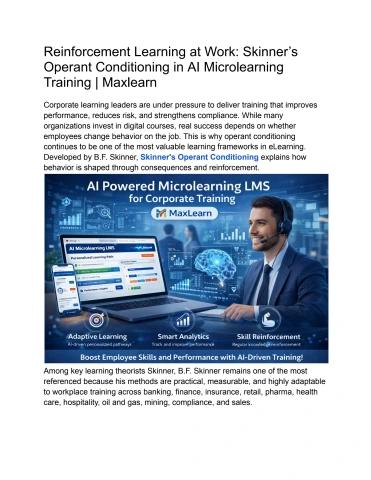
MaxLearn brings reinforcement learning into modern corporate training through an advanced AI-powered microlearning LMS for corporate training. The platform supports gamification, spaced repetition, adaptive learning paths, and performance tracking to improve retention and workplace behavior.
MaxLearn also offers powerful microlearning authoring tools so organizations can quickly build customized lessons. With scalable microlearning software, effective microlearning tools, and a flexible microlearning application, MaxLearn delivers one of the most complete solutions among today’s Microlearning Platforms through its modern microlearning LMS.
Conclusion
By combining Skinner's theory of learning with microlearning delivery, organizations can build training programs that create lasting workplace behavior change. MaxLearn makes it easier to apply Skinnerian conditioning at scale, improving compliance, performance, and workforce readiness across industries.
-
Follow
-
0
-
Embed
-
Share
-
Upload