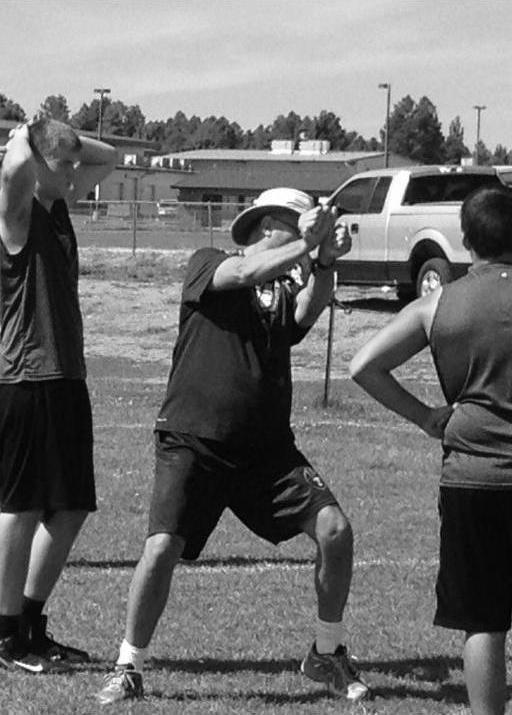
4.6 TYPES OF PASS PROTECTION SETS
Pass sets are determined by the alignment of the defender in relation to the blocker and the
QB. Shown below are alignments and how they are labeled.
3 Tech- 3 Set Pass Protection Sets
QB Fundamentals vs a 3 Tech- Call 3 Set. Kickstep keep
weight on Post Foot (Pound).OT use a Vertical Set If
2 Tech - 2 Set Lineman to inside has a 2 or outside technique
Y
Fundamentals vs 2 Tech- Call 2 Set. Replace Kick
Foot keeping weight on Post foot. Protect inside (
Heads Up for Press Slant or Twist)
Y
QB
1 Tech - 1 Set
Y Fundamentals vs 1 Tech- Call 1 Set. Set on Post
(Pound) Foot (Gain inside leverage on defender.)
QB Keep weight on Set (Kick) Foot.
Loose 3 - L 3 Set Fundamentals vs Loose 3 Tech- Call L-3 Set. Set
with Set Foot (Kick). Bring Post Foot (Pound) if
Y needed. OT use a Vertical Set If Lineman to inside
has a 2 or outside technique.
QB
Gap 1 Set- Call G-1 Set - Set with Post Foot 2X
Gap 1 - G 1 Set (Pound) Gain inside Leverage on defender
Y
QB
50
4.7 COACHING THE 3 SET
51
52
4.8 COACHING THE 2 SET
4.9 COACHING THE 1 SET
53
54
4.10 COACHING THE LOOSE 3 SET (WIDE RUSHER)
55
56
4.11 COACHING THE “GAP” SET
4.12 COACHING THE “JUMP” SET
57
4.13 PASS SETS DRILLS
58
59
60
4.13 CONTACT
Contact with the rusher is made with a punch of the hands into the chest area of the defender.
Listed below are techniques relating to the punch or contact phase of pass protection.
1. Timing of the punch is vital. Ideally, the elbows will lock out at the same moment as contact
is made with the rusher. If the punch is too early, there is a tendency to lean into the
defender plus there is no “pop” to stop the charge of the defender. If the punch is late, the
arms never get locked out which allows the defender to get his hands on the defender. The
blocker always wants to maintain separation between his body and the body of the
blocker.
2. The primary thrust is delivered with the heels of the hand. The thumbs are up, the fingers
extended loosely and the elbows in. If the elbows face out, the arms can be easily collapsed
by a bull rusher.
61
3. The punch starts at the shoulders and extends through the elbow, wrist, and hands. Don’t
lean forward during the punch. Maintain the bent knee position for power in stopping the
rusher.
4. The head and arms work together. When the arms extend, the head comes back with the
chin tucked.
5. On contact the base widens while maintaining a stagger. Continue to maintain the bent
knee position. The upper body is now more upright and rigid than before contact.
6. The blocker would prefer to punch at a slight upward angle. This can only be achieved if the
knees are bent which lowers the body allowing for the upward punch.
7. The player, either blocker or rusher, who first establishes effective hand placement, will
usually win.
8. Inside hand placement usually wins.
62
4.14 PUNCH
63
4.14.1 PUNCH PROGRESSION
64
65
66
67
4.15 AFTER CONTACT
68
69
4.16 PASS RUSH MOVES AND COUNTERS
The ability to counter a pass rush moves is important. Below are some common moves and their counters.
1. Bull Rush – the defender runs right through you in attempting to knock you back to the QB.
a) Counter “Hop Hop Drive”
i) Brace up as if you were being “pushed” off a cliff.”
ii) Maintain the stagger. If the defender has leverage and is “walking” the blocker back to the QB
because the blocker has lost his stagger, the blocker should “hop-hop” back with the feet to regain
the stagger. Keep knees bent The blocker may lose a little ground by doing this but he will regain
his base. This is much better than continuing to be walked back by the rusher because of a lost
stagger.
iii) If inside hand placement has been lost, re-establish inside hand position by bringing hands under
the defenders arms, and then aggressively up into his chest.
iv) As you feel the defender pull you forward after you stop him go with him by accelerating your feet
and aggressively drive blocking him.
2. Spinner – defender gives you a shoulder and spins out either way. Generally follows a quick bull move.
a) Counter
i) Use you hands as though you were rolling a barrel.
ii) Roll him in the direction he is spinning while placing your hands on his shoulders.
iii) You may give ground and match him in the direction he is spinning
iv) His objection is to get by your shoulders on the initial spin so you end up trailing him.
3. Swim - The rusher will grab a shoulder and pull, then attempt to bring his opposite arm over the blocker
while bringing his off leg past the leg of the blocker to the side of the pull.
a) Counter
i) First of all, make punch so effective that the defender misses the grab.
ii) If he gets the brab, the blocker presses hard with the hand to the side of the grab. DON’T ALLOW
THAT HAND TO LOSE CONTACT WITH THE DEFENDER. Press with more force than the defender is
pulling with.
iii) As the opposite arm swims over the blocker, the blocker places the hand to that side into the
armpit of the swim arm and pushes hard.
iv) Keep the foot and body moving in the direction of the swim move so the lane to the QB is shut off.
4. Rip - The rusher will rip his upper arm into the opposite arm pit area of the blocker, at the same time,
bringing the opposite leg past the leg of the blocker.
a) Counter
i) Clamp and trap the rip arm in the armpit.
ii) The blocker drops the center of gravity (with the rip arm trapped) to prevent the rusher from
completing the rip.
iii) With the off hand, the blocker pushes on the hip of the rusher to widen him.
iv) Keep the feet and body moving in the direction of the rip to shut off the rush lane to the QB.
70
5. Club - A move perfected by Howie Long of the Raiders, the rusher makes a quick move to one side of the
blocker, trying to get him to lean in that direct. The rusher than come back to the other side, at the same
time hitting the opposite upper arm of the blocker with a hard horizontal, straight armed clubbing action
with his arm. The intent is to push the blocker in the direction of the lean caused by the quick initial move,
thereby opening up a rush lane to the QB.
a) Counter
i) The key to countering this move is proper weight distribution and body mechanics.
ii) Keep the weight concentrated on the inside or post leg.
iii) Keep the nose over the crotch. Don’t lean in the direction of the initial move. If the blocker leans,
he will bail out and create a soft shoulder when he reacts to the change of direction by the rusher.
The rusher wants the blocker to lean in the direction of his initial move. Be patient. Time the
punch. Punching too early will cause a forward lean which is detrimental.
iv) After the punch, be strong with the arm being clubbed. If it gets knocked away, get it quickly back
into the frame of the defender and apply pressure. Keep the body and feet moving to stay in front
of the defender and shut off rush lanes to the QB.
6. Hand Slap - A hand slapper wants to knock the hands down and prevent the blocker from getting his hands
on the defender. If can also distract the blocker from executing his other techniques.
a) Counter
i) The first things to remember is that, if the defender is slapping, he’s not grabbing. In other works,
while he’s involved in trying to knock the blocker’s hands away, he’s not grabbing the blocker or
getting his hands on the blocker in a meaningful way. So the key is for the blocker to not be
distracted by the slap but to immediately after the slap, bring the hands back into position before
the defender can do the same with his hands. The ability to do this is aided by the hands and arms
being relaxed during the set and prior to contact.
ii) Once the hand position has been re-established, continue to go through with the basic pass
protection techniques.
iii) A very effective technique is the “fake jam”. A hand slapper relies on making contact with the
blocker, then getting into his pass rush move before the blocker can get his hands back in position.
A “fake jam” is merely showing the hands to the rusher, then pulling them back. If the blocker slaps
and misses, his timing is disrupted and he has to start over on his rush. The blocker “fake jams”,
thenpunches into the body of the rusher after he has tried to slap and missed.
Drill : Defeating Moves
1. Defeat Bull Rush
2. Defeat Spin Rt/Left
3. Defeat Swim Rt/Left
4. Defeat Rip Rt/Left
71
4.17 BLOCKING TWISTS
72
73
5 LINE SKILLS CHECKLIST
AGILITY MON TUE WED THU FRI
Agility Bags
RUN BLOCKING
Stance/Run Demeanor
Footwork “Bird Dpg
Forearm Flipper
Drive block progression
Drive Block
Down Block
Reach Block
Backside Cut Off
Backside Cut Off Alley Break
Trap /Kickout
Wedge Block
Cut “Knife” Block
Combo Blocks
Double Team (Post Lead)
Cross Block & Calls
Fold Block
Sweep Drill & Calls
Bootleg Drill & Calls
Inside Trap Drill & Calls
Scissors and OT Drill
PASS PRO
Stance/ Pass Deamer
Punch Progression
Mirror Progression
Drive the bus
Pass Sets: 3 Set
Pass Sets: 2 Set
Pass Sets: 1 Set
Pass Sets: Loose 3
Pass Sets: Gap
Rush Counters
Blitz pick-up
Twist Pickup
74
Notes
Monday
Tuesday
Wednesday
Thursday
Friday
75
The words you are searching are inside this book. To get more targeted content, please make full-text search by clicking here.
Offensive Line Manual-1.0.compressed
Discover the best professional documents and content resources in AnyFlip Document Base.
Search